
That Current Affairs interview on neoliberalism is a travesty
Economic illiteracy at nearly every step

Nathan Robinson, the head of the socialist magazine Current Affairs, recently conducted an interview with Nick Hanauer and Eric Beinhocker. As it was nearing its end, one of the interviewees, Hanauer, mentioned the following ostensible economic fact:
Let me just say that a $30 minimum wage is about what it was in the '60s.
Robinson approvingly replied:
Just to be clear, you’re not talking crazy here.
Using my best movie narrator voice: As it turns out, Hanauer definitely was talking crazy here, and elsewhere as well. In 1968, the federal minimum wage reached $1.60, which today (adjusted for inflation) would stand in the mid-teens, so almost half of what Hanauer is suggesting.
But that’s the least we should worry about in this interview. The title of the piece is Neoliberal Economics Was a Con From The Start, and Robinson boasts how his two interviewees show “free-market fundamentalism” to have been “empirically discredited.” In actual fact, the interview doesn’t at all manage to show this, but it does inadvertently reveal a series of economic errors, misstatements, and empirical falsities on the part of the three people involved. I sure hope other Current Affairs resources are not as sloppy, especially when they’re making similarly brash claims to overturn whole economics fields and existing economic systems.
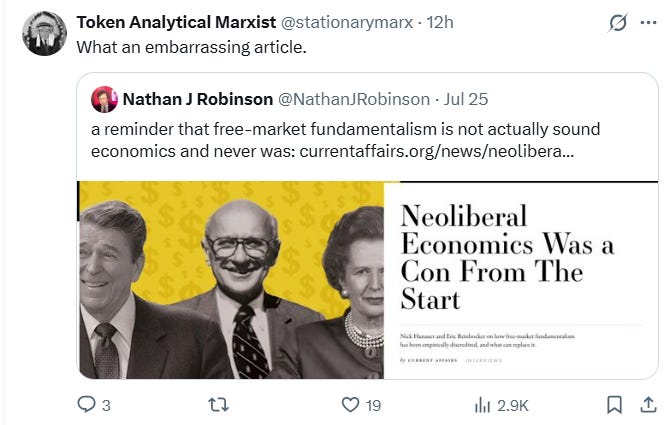
I should say I’m not the only one who’s noticed. Here’s how a guy a bit more ideologically aligned with Robinson than me put it.
Conceptual confusion
One of the absolute economics basics you should understand before opining on how the discipline/theory works, is the concept of economic equilibrium. It’s not a hard thing to get right, and it’s at the core of econ thinking. Very simply put, an equilibrium is a condition or state in which the relevant decisions and forces in a model are mutually consistent, and there is no tendency to change. That’s all.
Like, consider a car-dependent city. In it, people drive because public transport is infrequent and unreliable, and governments invest little in public transport because few people use it. Moreover, businesses build around cars because most customers arrive by car! Each decision reinforces the others. This is an unfortunate stable equilibrium, which no single commuter or firm can easily change alone, even though many people might prefer a city with better transit and less traffic.
Here’s what was said in the interview:
the contemporary sort of orthodox understanding of the economy is to conceive of it as an equilibrium system. That is to say, a system within which if one thing goes up, another thing has to come down. And so if you believe that, then it is effectively true by definition that if you raise the minimum wage, for example, there has to be corresponding job loss.
Impressively, this is wrong in three or four ways, not just one. First, it’s just a wrong description of how the “orthodox understanding of the economy” thinks of equilibrium. Second, a system in which if one thing goes up, another thing must come down kind of, maybe, resembles the logic of zero-sum. But why would you conflate that with an equilibrium? Third, economics doesn’t state “by definition” that if you raise the minimum wage, there has to be corresponding job loss. It’s all about the model: the perfect competition model does lead to that conclusion, but the monopsony model doesn’t (at least not if the wage increase is not extreme)! Fourth, economics has given us a lot of empirical research, a majority of which shows minimum wage increases don’t lead to corresponding job losses. (Depending on what exactly you mean, I’ll come back to this issue.)
Unfortunately, it doesn’t seem this is a one-off lapse in judgement. Look at this:
For 50 years or so, we in the West, and particularly in the United States, have adopted a framework of economics that we variously call ‘neoliberalism’ or ‘neoclassical economics’ or ‘trickle-down economics’ that structured the rules in ways that advantage capital above all else and disadvantage everything else.
If I squint really hard, maybe this is somewhat passable? But not really? I mean, how can you identify neoclassical economics with neoliberalism? Neoliberalism is of course itself a notoriously hard phenomenon to define and probably an essentially contested concept, but speaking broadly, we typically mean “deregulation, privatization, liberalization” when invoking it. That’s not completely unrelated to neoclassical economics, but the latter is a field of study, the former a system or set of real-world institutions and policies.
Moreover, neoclassical economics has a lot to say about externalities and market failure in general, offers loads of different models (with some being quite inimical to neoliberal policies), and the attitudes and preferences of its practitioners - neoclassical economists - are far removed from the trickle-down, neoliberal caricatures they are made out to be by socialists, anti-capitalists, and post-liberals of today. Can we, please, not treat neoliberalism and neoclassical econ as mere synonyms, especially in a piece ostensibly devoted to an in-depth analysis of these very issues?
This further silliness below requires no comment, so let me just highlight it:
[T]he interesting thing about the game of Monopoly is, no matter how many times you play it and who is playing it, it always ends up in the same result—a plutocrat.
…
Exactly. And what we point out is that a market economy is a game like Monopoly. That’s the takeaway. … A thriving middle class does not emerge naturally from a market economy.
Empirical falsities
It’s one thing to make a relatively minor mistake about how much the 1960s minimum wage would represent in today’s dollars. You’d be an unreasonable stickler and probably an ideologue if you made too much out of that. But the relatively minor mistake becomes more reasonably irksome when you consider all the other, sweeping mistakes made in the interview.
The biggest one is probably the claim about income stagnation and life becoming worse off over time. Both interviewees make this inexcusable error:
Incomes stagnated, social mobility dropped, and the middle class hollowed out.
…
[F]amilies have been waking up every day for 50 years, no matter who was in power, to a circumstance where they were worse off, while a few people at the very top were better off.
This is spectacularly wrong. Incomes in the United States have not stagnated in recent decades (or in the past half-century). Real, inflation-adjusted median (not average) personal income has increased by 70% between 1980 and 2024. Okay, but that’s the median person. What about someone poor, like a person in the 3rd decile by income? The increase has been a bit more than 50% over the same time period. Also relevant, according to BLS consumer expenditure surveys, between 1985 and 2023, the share of income Americans spent on clothing, food, and housing has dropped from 48% to 37%.
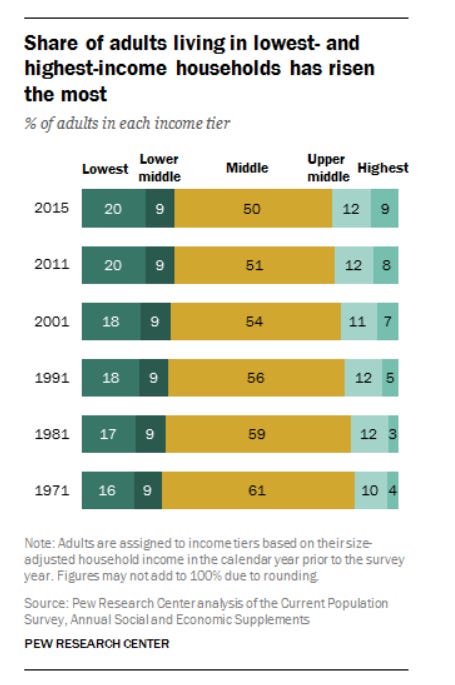
Social mobility and changing dynamics of the middle class are a complicated topic due to compositional issues, women entering the work force, and radical shifts in family dynamics. But even when looking at it simply, naively, the story told in the interview is not corroborated. The middle class has shrunk, yes, and the share at the bottom has even increased a bit, but there’s been movement at the top as well, and it accounts for an even larger share of the middle class decrease.
That is to say, the middle class has gotten smaller, but the upper-middle and highest class have gotten significantly bigger. I’m afraid people imagine “the hollowing of the middle class” to mean exclusively or almost exclusively downward mobility, especially when the statement is paired with explicit claims that “social mobility dropped.” In fact, both sides of the distribution increased, with the bottom going from 25% to 29% of adults, while the top climbed from a mere 14% of adults in 1971 to 21% today! Every fifth American is in the upper-middle or highest class nowadays. See below.
What else? One of the interviewees says this:
[T]he economists doing the empirical work kind of carried on, and they addressed the questions about the studies and did more studies and more studies and more studies, and they kept getting the same results that basically the minimum wage has no real negative impact on jobs, but has significant positive impacts on the wages of low-income workers, not just those on the minimum wage, but it also transfers up to other low-wage workers.
I appreciate the results of modern minimum-wage research very much myself, and have mentioned in the past that the old economics consensus (before the ground-breaking quasi-experimental research from the 1990s) on deleterious minimum wage effects has rightly shifted. But let’s not overstate what has been shown in recent decades. This is how I characterized the issues last year:
It’s sometimes said that the shift in consensus on this issue since the credibility revolution has been dramatic. For instance, the story goes that in 1978, surveys found that around 90% of economists thought minimum wages markedly increase unemployment among low-paid workers. In 2015, the share of such economists was only 26%. In reality, it’s more complicated than that. As a case in point, a more recent survey (done in 2021) shows 45% of economists still agreeing that the minimum wage can have negative effects for low-wage workers in many states. No doubt, there’s been a clear and to my mind justifiable shift of opinion over the long term, but definitely not as much as some proponents of the minimum wage imagine.
Also, just going off the big recent Dube and Lindner review chapter, I think the least we can say is that:
Point estimates for particular narrow groups of workers do lean mildly negative.
Yes, estimates covering the broad population of affected workers are centered more toward zero, and I tend to believe that result. But it’s not the only conclusion worth emphasizing.
Additionally, there are studies that report larger negative effects, which we also shouldn’t overlook, at least not in highly specific contexts, though these tend to be more scarce.
You can’t just paper over all of that.
Here’s another howler.
It [i.e., the minimum wage] also increases spending in local communities and has no negative impact on prices that anybody’s been able to find, and so on.
Huh? There are literal meta-analyses, like this one done on hundreds of estimates that suggests “a 10% increase in the minimum wage leads to a 0.3 to 1.1% rise in prices.” These are not just one-off studies, and even minimum-wage proponents like Dube and Lindner say that “higher prices may be one of the margins through which firms offset higher labor costs and not reduce employment in response to higher minimum wages.” There are of course cool thing to talk about here, like how better studies (utilizing quasi-experimental techniques) find much smaller increases in prices than standard regressions. Moreover, there’s interesting and expected heterogeneity, like the price elasticity being larger for labor-intensive goods. But good god, man, “no negative impact of prices that anybody’s been able to find?” What are you on about?
Same with this:
[T]he other thing you often hear is, "Well, it's technology change and globalization—can't do anything about those. Tough luck, workers." We have this thing called skill bias technical change. But when you look at the data, these [inequality] trends started back in the mid '70s and early '80s, and the trade and technology stories are very real and have had a powerful effect on the economy, but they don't really start until the 1990s. So something else was going on during this period, and that something else, we believe, was the changes in policy wrought by the neoliberal economic revolution.
Trade and technology stories don’t really start explaining inequality until the 1990s? That’s not at all true. Research on computerization found unusually rapid growth in demand for college-educated workers over 1970–1995 (with skill upgrading especially pronounced in computer-intensive industries). So, skill-biased technological change was already one of the main proposed explanations for the sharp rise in wage inequality during the 1980s. And it’s similar with globalization. International outsourcing and import competition were already affecting American production and relative wages during the 1980s. Feenstra and Hanson explicitly studied the decline in the relative employment and wages of less-skilled workers in that decade and identified rising imports and outsourcing as a contributing factor.
Another self-evidently crazy claim:
When the middle class thrives, that’s what creates economic growth. The thriving middle class is the cause of economic growth, not its consequence.
There are still other substantial errors in the piece, but I’ve had enough, and you probably have as well. Don’t get me wrong, you can make good critiques of some economics reasoning (see my recent piece on the Invisible Hand Theorem), question aspects of neoliberalism and free markets or undue opposition to state ownership, and you should argue in favor of social democracy and the welfare state. But what these guys are doing is not the way.
This was a particularly unserious read from Current Affairs.
I wish there were more intellectually honest political thinkers like you.
I feel like the root issue is an essential absence of model-level understanding of economic systems as governed by sets of interrelated mechanics.