
Pinker is wrong and correct about human war and violence
An appreciative critique of The Better Angels of Our Nature

I first got interested in the nature of human violence and the origins of war (the “empirical Hobbes-Rousseau debate”) back in 2015, while I was working on my PhD. I have to admit that, both because I was a Marxist and due to some other more trivial reasons, I was strongly inclined – even before looking at the research literature – to believe in the Rousseauian perspective. Humans are not naturally violent or prone to dominate others, I thought, but class systems and inequalities can push us in that direction.
My tumultuous journey through the violence literature
In any case, when I decided to look at the evidence, I quickly found Douglas Fry’s 2013 edited volume War, Peace, and Human Nature. I read some of the chapters in detail but only skimmed the rest of the book. My impression after doing so was that the fields of anthropology and archaeology had mostly corroborated the Rousseauian view, and I was pleased enough with this impression that I lost the motivation to look into the matter further.
Years later, as I was shedding my Marxism, I felt a renewed interest in looking at the topic with a fresh set of eyes. Around 2019, I decided to carefully read through two oversized books I’d known about before but had felt were too ideologically compromised to be worth it. The first was Steven Pinker’s The Better Angels of Our Nature, the other was Azar Gat’s War in Human Civilization.1 I was hooked almost immediately, and I guess that should have been a warning sign, especially after my misguided dalliance with Marxism.
So, just as I had previously been fully – and in a distinctly un-self-aware way – taken in by the Rousseauian view, I was now quite committed to the Hobbesian view. Like before, I didn’t feel much of a need to go deeper into the literature. (Stupid, I know, but I console myself with the thought that this is par for the course when you’re excited and in your twenties.)
Fortunately, just a few years later – and for reasons I cannot quite recall – I was again itching to read up on the anthropology and archaeology of violence and war in human history. There was no further ideological conversion this time, and I simply wanted to get to the bottom of things, or at least as far as I could reasonably go. An oversized book or two and just a few weeks of reading wouldn’t suffice. So I first dedicated the better part of a year to intensive study of the topic from all perspectives. I went through technical works and the data, I even talked with some people who actively worked on the issue, and I started forming a more systematically informed view with an explicit interest in at least partial synthesis of the diverging perspectives.
The outcome of that and some additional studying I did a bit later were two peer-reviewed pieces; reviewed mostly by anthropologists, archaeologists, and historians/international relations scholars, as far as I could tell from behind the veil of the double-blind review process. I ended up publishing the papers in the Journal of Peace Research (in 2022/23) and Theory and Society (2024), which I admit felt good.
I’m going to present the key snippets of what I learned in this post by way of simultaneously critiquing and appreciating Pinker’s Better Angels, which warts and all remains a book dear to my heart.
The violence Kuznets curve
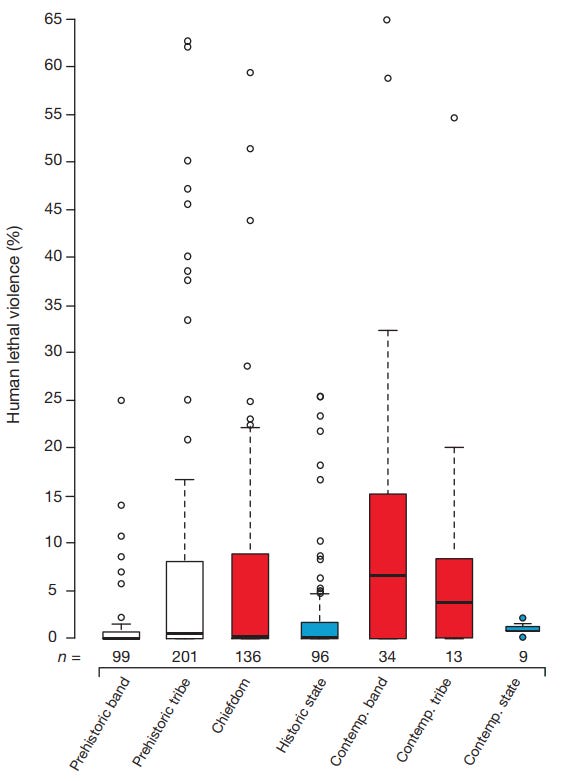
The general picture of human lethal violence and war from prehistory to today is that the pattern looks something like an inverted-U curve (or simply an “n”).
Interpersonal violence (including war) was:
(1) present but probably of relatively low/moderate intensity in deep prehistory (we have clear evidence for homicide, while warring was likely only occasional),
(2) then violence and wars rose sharply with social complexification and sedentism,
(3) and then fell again with the consolidation of states and further still with the institutions of modernity.
Something akin to this can be seen in the figure below.
There is an obvious conceptual issue with how we distinguish mere interpersonal violence from war. In theory, there is a relatively clear distinction between person-on-person violence (homicide, murder) and group-on-group violence (coalitionary violence, raids, war). But raids and feuds among hunter-gatherers can be groupish and war-like while also being partly interpersonal, so in practice it’s sometimes hard to make firm separations. There are other issues as well, most notably having to do with how we measure and tally up lethal violence metrics, but leave that aside for now.
Pinker is wrong about war and death rates in deep prehistory
Pinker’s implication that life in the state of nature (which characterized most of humankind’s existence up till complexification, sedentism, agriculture and later the rise of states) was already soaked in chronic warfare, that violent lethality rates were exceedingly high, and that it mostly only gets better from there on is not correct. This is an important error.
One of Pinker’s main sources here is Bowles. But the sample Bowles used is a shaky stand-in for nomadic, prehistorically appropriate hunter-gatherers. Quite a few of the groups in the sample are complex foragers and horticulturalists, which likely appeared much later (though before the rise of states). Moreover, in at least two of Bowles’ cases (the Ache and the Hiwi) the “war deaths” are actually inflicted by frontier ranchers rather than by the foragers themselves. When those kinds of issues are corrected, the headline violent lethality numbers (originally as high as 14% of all deaths) deflate significantly. Keep that artificially high figure in mind when reading the next section.
When you look at other comparative work, there are further considerations to think about. Fry and Söderberg’s prehistorically appropriate and larger sample suggests that around half of the societies they examine show no lethal events involving more than one perpetrator, which is hardly the signature of pervasive coalitionary killing. In one of his other samples, Fry codes only a minority (38%) of nomadic foragers as warring. (To be fair, since learning of Luke Glowacki’s 2025 critique of both studies, I’m less sure of these results.)
Systematic archaeology also makes it seem that there was not that much war in prehistory. For instance, Ferguson’s reanalysis of Pinker’s commonly cited set of cases argues that several should be excluded because they’re single violent deaths (insufficient for war), duplicates, or highly unusual cases that distort inferences about antiquity and lethality. Broad reviews of the archaeological record should also make you think that something is amiss in Pinker’s account. Haas and Piscitelli argue there’s a fairly clear line that can be drawn at around ~8,000 BC, after which the evidence for localized warfare becomes significantly more visible, while before that point the skeletal record offers “little, if any, reliable indication of war.”
Don’t misunderstand me. When Pinker’s critics say they’re sure there’s no evidence of war in deep prehistory, I think that’s definitely overstated. For one, absence of evidence is not necessarily evidence of absence, and preservation in prehistory is uneven for obvious reasons. Moreover, both the Jebel Sahaba site and Nataruk (Kenya) suggest war was sometimes being practiced by prehistorical nomadic foragers; although it’s actually not clear Jebel Sahaba offers evidence of war specifically, and it’s the same with Nataruk! In any case, there are good reasons to be skeptical of the claim that war was ubiquitous or particularly intense, given the archaeological record.
Multiple things can be true at the same time. I think the following is a fair summary. (a) Nomadic hunter-gatherers were perfectly capable of murder and could be quite (though not exceedingly) interpersonally violent. But also, (b) intergroup warfare between such bands was much rarer than Pinker implies, and likely not the dominant feature of most of deep prehistory. Modal prehistorical societies (nomadic foragers) in general experienced much lower violent lethality rates than claimed or implied by Pinker.
Violence grew significantly with complexification
As societies started becoming more complex, more sedentary, more resource-dense, and more politically stratified – but before the state had emerged – the evidence supports a sharp rise in violent lethality relative to nomadic foragers. The true violence perpetrators were thus complex hunter-gatherers, horticulturalists, early agriculturalists, and chiefdom-like formations.
Quantitatively, when you do what Pinker often doesn’t do – when you separate prehistorically appropriate nomadic foragers from the broader bucket of non-state societies – the difference is far from trivial. Using the ethnographic violent lethality datasets that both sides of the debate commonly cite, if you restrict attention to nomadic foragers, you get an estimate of around 122 violent deaths per 100,000, whereas the broader proxy for pre-state agricultural societies comes out around 486 and up to almost 600 per 100,000, depending on the data source.
The archaeological comparisons that target the pre-agricultural versus early agricultural transition show much the same. Halstead and Thomson’s repurposing of the Gómez et al. dataset finds pre-agricultural violent mortality around 1.7% (of all deaths) versus 5.2% for early agricultural skeletons in the early Holocene, roughly a 1:3 ratio, and their adjusted figures preserve that ratio (3.4% vs 9.2%). (Remember Bowles’ 14% figure, cited by Pinker?) When expressed as deaths per 100,000 per year using estimated population sizes, the numbers still roughly match the ethnographic pattern (on the order of 103/100,000 vs. 277/100,000).
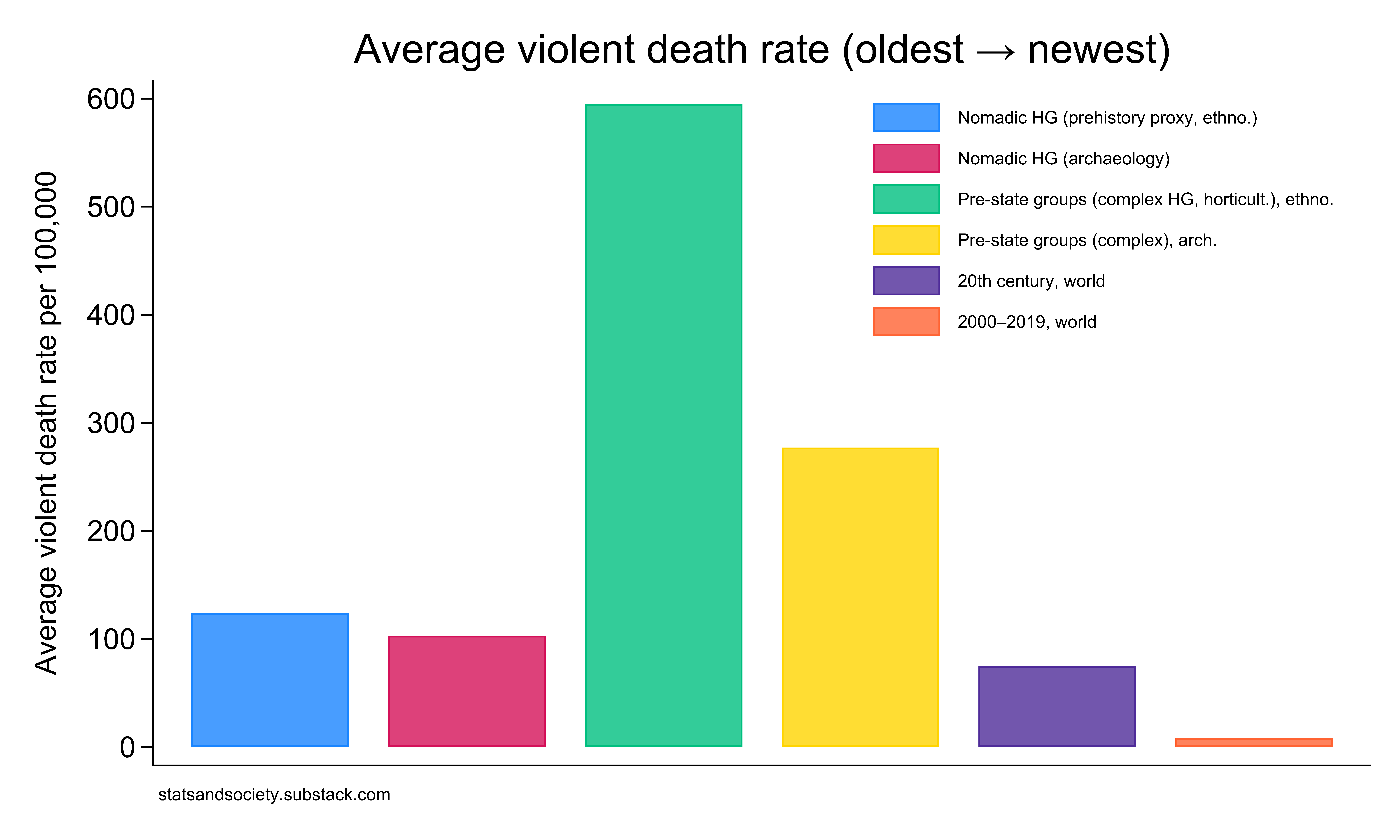
So, to repeat, as I put it in my 2023 Journal of Peace Research paper (“The prehistory of violence and war: Moving beyond the Hobbes–Rousseau quagmire”):
In summary, contemporary studies based on more robust methodological principles suggest a much lower (though not vanishingly small) lethality and tendency of nomadic HGs to engage in war than suggested by popular accounts such as Pinker (2011).
I’m not the only one who’s broadly sympathetic to Pinker but at the same time critical of him on these points. Here’s an observation by Hugo Meijer in his recent 2024 review “The Origins of War: A Global Archaeological Review” (published in Human Nature):
These findings strongly challenge the view put forward by scholars such as Azar Gat and Steven Pinker, who argue that war-torn prehistoric societies experienced 15% adult mortality due to warfare…
Or Halstead and Thomson (in their 2022 “Violence Before Agriculture” report):
Estimates for pre-agricultural rates of violence in Better Angels are much too high. Notably, both our ethnographic and archeological evidence indicates that the pre-agricultural period was significantly less violent than the widely cited figures from Better Angels would suggest.
Pinker is correct about the Leviathan and modernity
Once we cross into actual state formation and the long arc of modernity, Pinker becomes, in broad strokes, right – sometimes even more right than his critics want to admit. If you compare violent lethality in state societies to the broader non-state proxy, the state average is much lower.
One benchmark I looked at in my paper is a moving global average of deaths in conflicts between 1400 and 2000 (including military and civilian deaths in wars, genocides, and non-state conflicts) that fluctuates between roughly 1 and almost 200 per 100,000, with a decadal average around 18.8 per 100,000. (This conflict-based figure doesn’t include homicides, which is why it’s not a complete measure of overall violence. For different periods, you have to include different rates of homicide, like 10, 20, 30, or more, to get to the total number.)
Likewise, Gómez et al.’s estimates suggest that observed violent lethality falls sharply in the Modern and Contemporary periods to levels that are not only lower than earlier agricultural peaks, but even below a phylogenetically inferred baseline. The same goes for historic and contemporary states.
This is where I think Pinker’s story (involving states, markets, and so on) is broadly correct. State consolidation likely matters because it changes the incentives and capacities around violence by suppressing local cycles of revenge, monopolizing legitimate coercion, and increase the costs of private violence. Modernity helps structurally by introducing and spreading democracy and capitalism (and perhaps international institutions) and those explain why peace flourished especially in the modern West.
Still, within the last six centuries, war death rates swing wildly from period to period (though homicides are continuously going down). There are centuries where averages are low, then spikes to catastrophically high levels, then declines again. This kind of volatility is, I think, one reason some reasonable critics argue that there is no additional long-term decline of war, at least not over the past several centuries. The data is not that good, so we can’t really know.
What is clear, however, is that the biggest drop happens after 1950. On that specific issue (whether the “long peace” is real) Pinker is on relatively strong ground. Great-power war has been dropping across the last half millennium, and in the last 70 years there have been no great-power wars at all. After World War II, and especially after 1990 (the “new peace”), even interstate wars have been less frequent and less lethal.
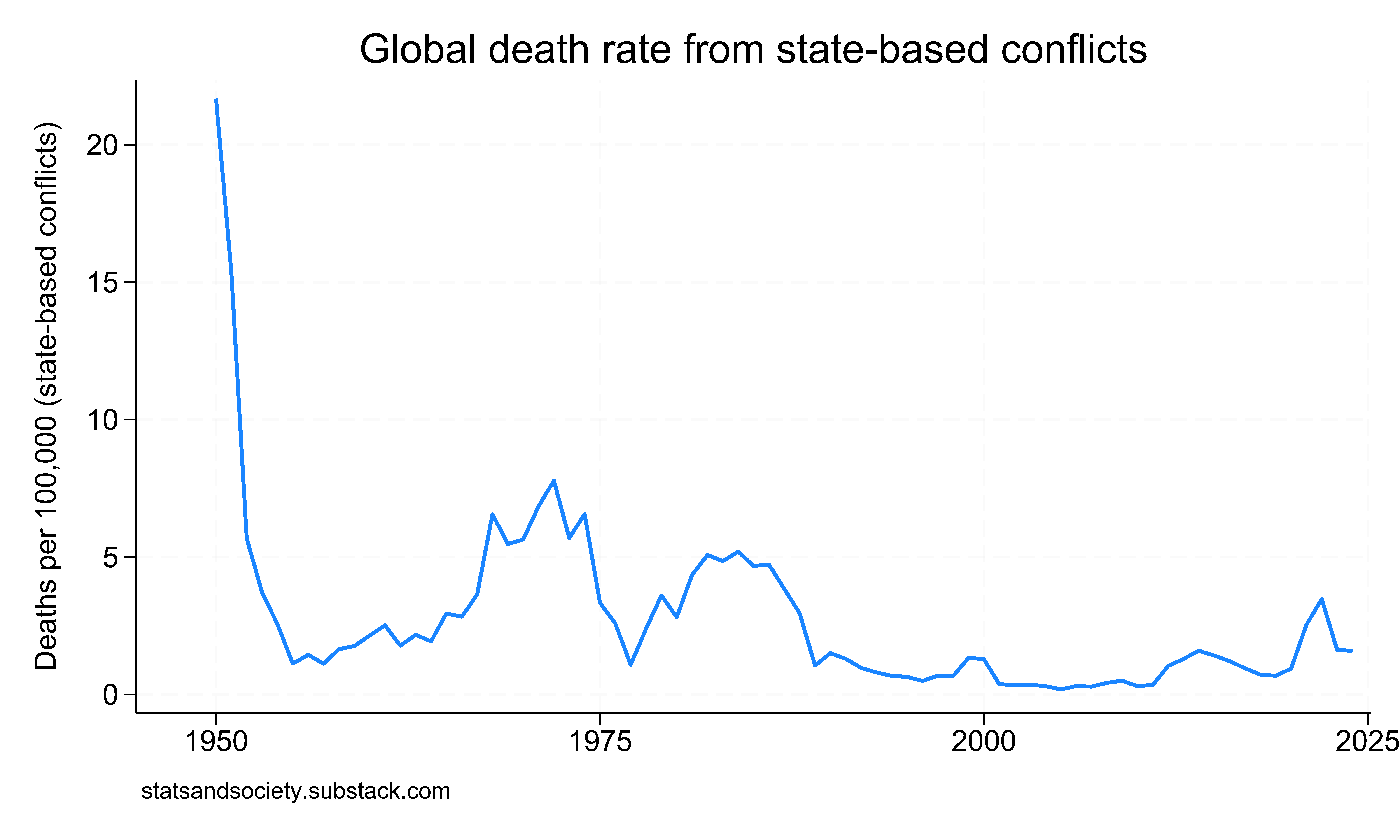
There have been recent increases in violent death rates tied to major conflicts (Syria, Tigray war, Gaza-Israel, and Russia’s invasion of Ukraine), but those increases still sit well within (below!) late-Cold War levels rather than returning us to the catastrophe-scale lethality that dominated some earlier periods.
There’s a lot to add here – for instance, can we extrapolate the trend into the future or is the “long peace” just a random blip? – but I’ll return to these topics over the coming months! I’m already working on a piece about the democratic peace and capitalist peace theories.
I was also at first quite impressed by Gat’s two more (then recent-ish) papers on the topic: “Is war declining – and why?,” from the Journal of Peace Research (2012), and “Proving communal warfare among hunter-gatherers: The quasi-rousseauan error,” from Evolutionary Anthropology (2015).
Great post. I guess as a non-expert, my sense is that the evidence of hunter-gatherer lifestyles is so weak and uncertain, the ideological biases are so strong and almost entirely in one direction (in Fry's cases the desired conclusion is pretty explicit if I remember correctly), and the space for social scientists to select, frame, interpret, etc, results in biased ways is so vast that I don't have much confidence in any conclusions in this area. Another question I have is what is really at stake in disputes about the rate of violence among hunger-gatherers. Even if it's true that the rate of violence is relatively low, it doesn't follow that humans aren't "naturally" violent, competitive, etc. It might just be that with extremely small scale mobile subsistence societies violence doesn't generally pay in terms of expected value. That story would predict that when the incentives change, people can quickly become much more violent, which the history seems to support. Anyway, just some thoughts that occurred to me whilst reading. Thanks!
Thanks for this post, which is both interesting and useful. I look forward to reading your two articles.
I will mention that, in some ways, Pinker can be his own worst enemy. If you read the preface and Intro to the book (which lots of people do), you get the impression that when it comes to warfare, he’s arguing for ultra-steep declines in rates, analogous to homicide and execution; but f you read the chapter on Great Power wars (which apparently few people do), the actual claim is much weaker (trendless fluctuation).