
No, capitalist liberal democracies – like the US – are not oligarchies

Matt McManus, the author behind The Political Theory of Liberal Socialism and What is Liberal Socialism?, and just an all-around fun and friendly guy I’ve had a few exchanges with over the years, posted this the other day on X:
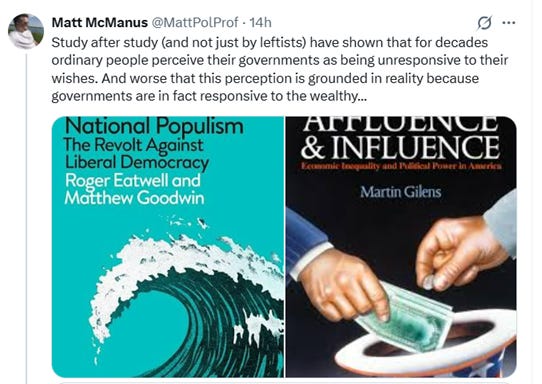
Yes, there is a vast literature that has accumulated on this topic since the 2000s. But I think Matt’s reading of it might be biased. Of course, if he’s only saying, minimally, that ordinary people (that is, poor or middle classes) are somewhat more likely to perceive their governments as being unresponsive in comparison to richer people, and that there is some reality to this perception, I have no issue with him. But if the idea is that liberal democracies, such as the US and other advanced societies, are virtually plutocratic, hollowed-out non-democracies where ordinary people have close to no say compared to rich folks, are locked out of the system and just generally not represented, this is just emphatically not true.
Here’s a relatively brief list of the key points that I think should be made in any non-biased review of the political science literature Matt is referring to. See for yourself if any of the points surprises you, given your own priors and the image that popped into your head after reading Matt’s X post.
(By the way, he read the post and wasn’t wholly pleased with my framing of him. Here’s his response for context. I don’t want people to get the wrong impression: Matt is decidedly not saying that currently existing liberal democracy is a plutocratic sham.)
1. The responsiveness gap exists, though there are dissenting studies as well. Everyone knows about the infamous 2014 Gilens and Page study. But that’s nothing, really. There are so many more studies than just “Gilens and Page.” And many studies in this area (most, actually, not just many) have indeed found that governments are more responsive to the preferences of wealthier citizens than to those of poorer ones. This holds both for the US and elsewhere; mostly Europe, but globally as well in some larger samples that we have.
However, a non-trivial number of papers also show that either there’s no such gap in policy responsiveness, or find the bias running in the opposite direction – that is, toward lower-income groups. The literature is not uniformly damning, so let’s not present it as such.
That said, I think it’s fairly clear that the overall weight of evidence does suggest a gap probably exists. This should just be accepted. Here’s how a recent state-of-the-art review puts it:
[M]ost studies find a positive income gradient in political responsiveness, indicating that political outcomes respond more strongly to the preferences of higher-income groups. …
Some studies find relatively equal levels of political responsiveness [1, 2, 3], some find that political outcomes best reflect the preferences of the poor [4, 5], and still others find that political outcomes respond most strongly to the preferences of the middle class [6].
This divergence in results is often downplayed in scholarly and public discussions of the literature, yet it stands out clearly here.
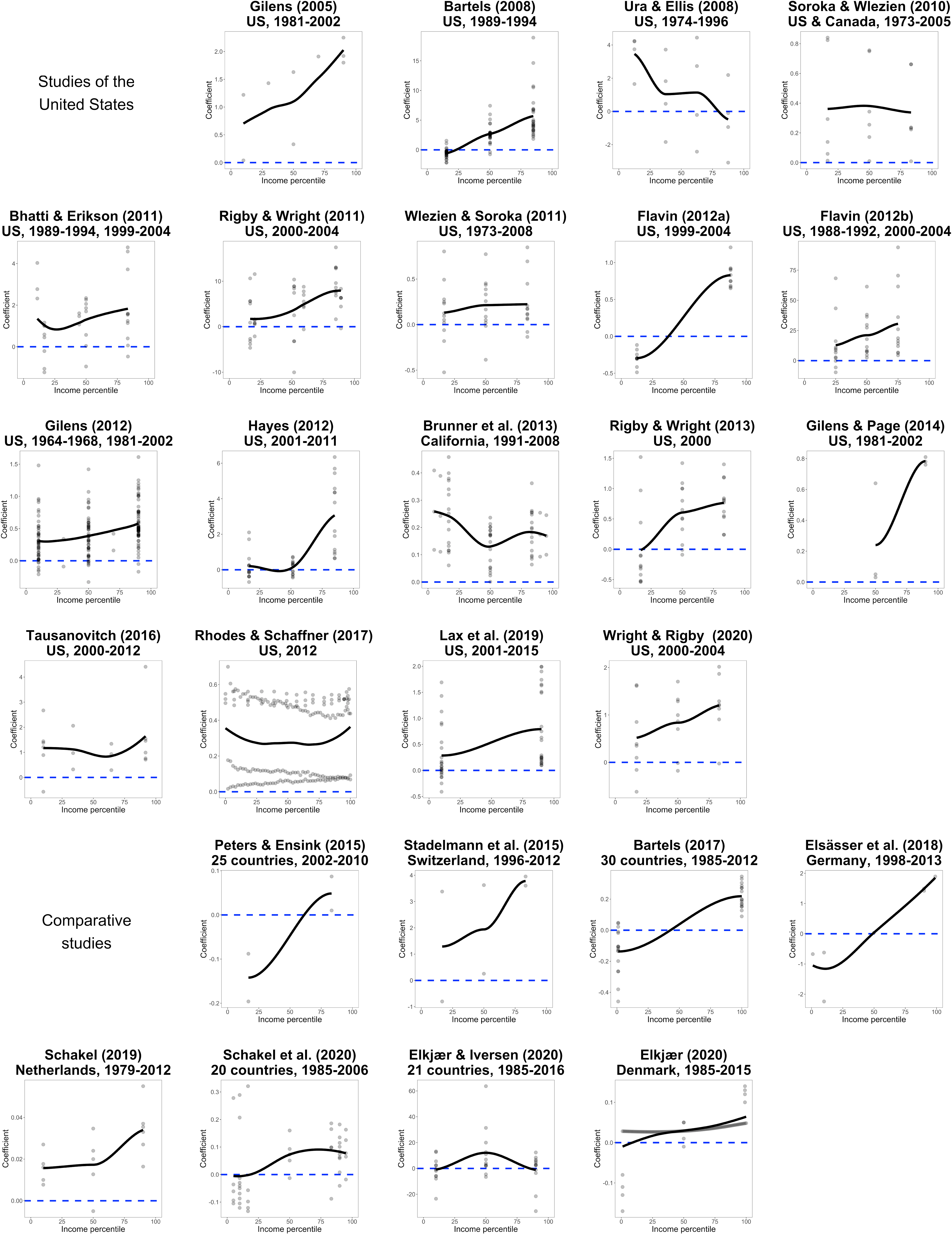
Now, the obvious and important next question is what its magnitude is and what is actually driving it.
2. The gap is quite modest. On the matter of magnitude, the evidence gives reason for considerable restraint in how we characterize the problem. Persson and Sundell, working with a sample of 30 European countries, recently found that the policy preferences of low-income citizens were congruent with actual policy outcomes 53.66% of the time. For middle-income citizens, the figure rose modestly to 55.12%, and for high-income citizens to 57.06%. The gap between the bottom and top of the income distribution, in other words, amounts to roughly 3 percentage points – which is why the authors titled their study “The Rich Have a Slight Edge” and not anything more dramatic. If taken at face value, this is no obvious demonstration of robust, undeniable political oligarchy.
Schakel and colleagues, examining a larger sample of 43 countries, arrived at similar numbers. The least advantaged social group, defined by both low income and low education, had preference-policy congruence of 52.7%, while the most advantaged – high income and high education – had congruence of 57.6%.
3. But perhaps a “better measured” gap would be bigger? There is a structural reason to suspect that these estimates may actually understate the true degree of representational inequality. That’s because the preferences of people at different points in the income distribution tend to be substantially correlated. Rich and poor citizens frequently want the same things, or at least do not disagree as sharply as one might expect. This is itself an important empirical fact that tends to be underemphasized in discussions about political inequality, but it also has a methodological implication. Namely, when the groups being compared hold similar preferences much of the time, there is a natural ceiling on how unequal representation can appear to be.
As one formulation of this point in the literature goes, even if the rich are the ones effectively driving public policy, the preferences of lower-income groups will still be registered as “represented” much of the time – simply because their preferences happen to coincide with those of the more influential group. Congruence figures, in other words, can look equal even if the underlying process of influence is quite unequal. (A related statistical problem is that if the preferences of different income groups are highly collinear, as they are, multivariate analyses designed to isolate the independent effect of each group’s preferences become unstable and potentially uninformative. But let’s leave that for another day.)
4. Okay, run a more decisive test then. Branham and colleagues devised an approach intended to sidestep this problem by restricting the analysis to cases of disagreement between income groups. By focusing only on instances where the preferences of high- and low-income citizens diverge, we have at what amounts to a cleaner test of differential responsiveness. But it turns out that when examining only these contentious, high-stakes cases of real disagreement, the rich in the US do not dominate overwhelmingly at all. The probability of the rich getting the policy outcome they prefer, as against the middle class, comes out at roughly 53% versus 47%. This is something, but again no oligarchy worth its salt would be this weakly tilted in favor of the elites.
5. Lower income, less information? A further complication for any simple account of plutocratic capture has to do with the role of political information and how it interacts with measured preferences. Elkjær and Iversen have pointed out, through simulation, that if wealthier citizens are better informed about politics and policy – which the evidence suggests they are – then standard statistical models studying changes in policy over time can produce the appearance of rich-only influence even if that is not true. What this means, methodologically, is that studies of short-term policy changes may be telling us more about differential information than about differences in political power. Elkjær and Iversen’s proposed remedy is to study long-run levels of policy instead of short-term ones, since the former is less susceptible to this form of bias.
When they use this approach on a sample of 21 advanced democracies, the results are again complicated. Short-term changes in spending do appear to track the preferences of the rich, but the long-run levels of policy appear to be set by the preferences of the middle class. As they themselves conclude:
middle-class power has remained remarkably strong over time, even as inequality has risen. The authors conclude that the rich have little influence on redistributive policies, and that the democratic state is apparently not increasingly constrained by global capital.
Elkjær’s subsequent work using Danish data shows much the same. Denmark displays the same pattern of differential responsiveness seen elsewhere, but the result appears to be driven primarily by the fact that wealthier Danes hold preferences that are more closely aligned with standard macroeconomic policy stances. As he puts it:
unequal responsiveness reflects asymmetries in information about fiscal policy across income classes, as opposed to being a structural bias inherent in capitalist democracy.
6. It might be more about education and culture than income and economic issues. Much of the literature on political inequality has been organized around income as the primary dimension of stratification, but a (slowly) growing body of work suggests this focus may be missing something important. There are only a few studies here, so we should be careful. But, as Schakel and colleagues have found, education appears to have a stronger effect on policy representation biases than income does, when both are examined. Moreover, the largest and most consistent gaps in both congruence and responsiveness appear not on economic policy questions but on socio-cultural ones. And on the economic dimension, responsiveness to lower-income citizens is actually relatively okay. It’s just on the socio-cultural dimension – questions of immigration, identity, social liberalism, and the like – where lower-educated and lower-income citizens find their preferences least reflected in policy.
If this is true, unequal political representation is not necessarily so much about redistribution or economic policy, as one would naturally think, but much more about the cultural and social agenda, where the preferences of the less educated diverge most from those of the educated professional class.
7. And it’s actually about Europe more so than the US! One would think that if any capitalist liberal democracy is being warped and skewed toward oligarchy, it’d be the US, perhaps on account of its weaker labor union tradition, higher inequality, corporate power, lesser regulation, and so on. But if anything, the reverse seems to be the case, which is very weird. Here’s how the systematic review mentioned before reports this puzzling result:
published research suggests that differentials in responsiveness are weaker in the United States compared to other developed democracies. … Moreover, studies of the United States are more than four times as likely as comparative studies to observe a pro-poor bias …
Considering that the countries studied in the comparative literature (Canada, Denmark, Germany, Netherlands, Switzerland, and developed democracies more generally) have lower levels of economic inequality, stronger left parties and labor unions, higher turnout rates, and less money in politics than the United States, these results are puzzling. They go against conjectures that the United States might be a unique case regarding political inequality. They also challenge long-standing theories in comparative political economy, which explain the more egalitarian political outcomes in Europe partly as a function of political and economic institutions, a stronger working class, and greater political influence of low-income groups. …
Why social Europe appears to experience more unequal representation than liberal America is puzzling and warrants further scrutiny.
Next time you or your friends do the whole “Gilens and Page (2014)” spiel, remember these points!
Personally, this is my preferred study because it overcomes a lot of the issues in both Gilens’ method as well as Branham et al.’s: https://onlinelibrary.wiley.com/doi/10.1111/ssqu.12791
> Why social Europe appears to experience more unequal representation than liberal America is puzzling and warrants further scrutiny.
My Italian partner would explain this by arguing that the educated elite of Europe have more of a stranglehold on politics and policy in Europe than in America.
Is that actually the reason? 🤷♂️