

A familiar worry in modern society is that markets corrode moral life. Even before Marxist arguments about capitalism turning us into selfish curmudgeons started appearing, the (fairly intuitive) idea was that money, profit, and exchange are brutish and unexalted. The implication is that once markets and money penetrate the whole of society, crude, selfish behavior likely spreads.
Of course, there were always also people defending the opposite view, namely, that markets not only aren’t morally disruptive but instead make us more cooperative, trusting, and peaceful. It’s not my intention to summarize both of these “rival interpretations of market society”, but you can browse a nice classic paper by Hirschman with the exact same title to get a taste for the theoretical backbone of both views.
What I do want to say is that the latter view – the doux commerce, or gentle/sweet commerce, thesis – has accumulated a surprising amount of (different varieties of) empirical data confirming it. Let’s go over a cool recent paper that brings an ingenious new dataset to the table.
Benjamin Enke has shown that where pre-industrial societies talked more about markets, their stories also leaned more toward prosocial morality (impersonal cooperation, universalism, etc.).
He did so by mining an extensive folklore catalogue covering 943 ethnolinguistic groups to build text-based indices for two things. First, an “importance of markets” measure based on the references to intercommunity trade and money in stories. Second, four morality measures: prosociality, trust, moral emotions, and a universalism index. Prosociality was measured as the difference between concepts like sharing, helping, and cooperating on the one hand and selfishness and self-interestedness on the other. Trust relates to interpersonal trust-related concepts. Moral emotions have to do with the frequency of concepts tied to guilt, shame, and anger. Moral universalism is a measure that weighs mentions of justice, fairness, equality, tolerance relative to group-bound ideals like family, homeland, obedience, cohesion.
In baseline analyses, he finds striking evidence corroborating the doux commerce view. Conditional on continent and on the sheer volume of recorded motifs, the markets index predicts higher prosociality, trust, universalism, and moral-emotion salience. Coefficients are large, roughly 0.29 for prosociality, 0.41 for trust, 0.40 for universalism, and 0.44 for moral emotions. These patterns hold when he adds a richer set of covariates and compares only societies inside the same modern country. They also hold when the comparison is narrowed to neighbouring groups within 100 kilometers, which helps with unobserved geographic or cultural drift and suggests plausible causal identification.
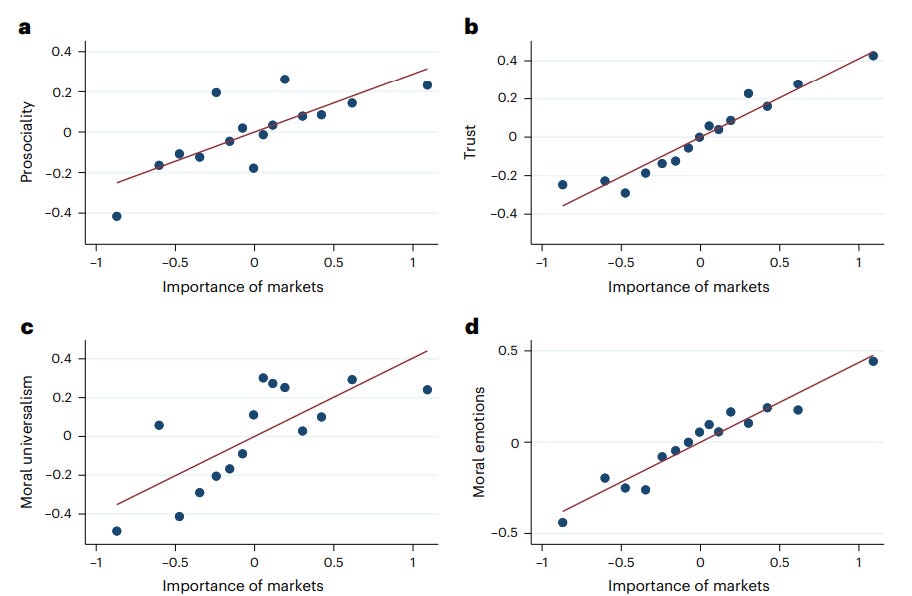
That’s very interesting and a win not just for the gentle commerce thesis but something that might be called quantitative ethnography as well! Obviously, causality is going to be the tricky part. But as Enke is an econometrician, he tries to do his best to move from correlation to causation.
To try and additionally correct for the possibility of reverse causation (morality —> markets) and omitted variable bias, he uses two instrumental variables that plausibly pushed trade and markets without being themselves set by moral preferences. The instruments are proximity to major historical trade routes and the ecological polarization of a homeland that raises the gains from exchange. The IV analyses point in the same direction. That is, at least some important part of the identified baseline correlation looks like markets causally shaping moral structure, not the other way around.
(Are the instruments really plausibly exogenous? I think so, but this is ultimately untestable. For trade routes, the logic is that societies typically settled in locations long before the first long-distance trade routes emerged (measured as distance to pre-600 AD and pre-1700 AD routes). Therefore, a society’s moral values would not have determined its proximity to these routes, even though proximity would have increased exposure to trade and money. For ecological polarization, the idea is that greater ecological diversity raises gains from exchange, thus causing markets. The key identification assumption is that societies did not settle in more or less ecologically diverse environments because of their moral values. Instead, societies first settled in locations that differed in their geographic propensity for trade, and then trade affected their moral systems.)1
But this is just one study, you might say. Sure. Here’s a few more representative ones with different measures, techniques, time periods, and populations (from around the world):
Henrich et al. (2001), “In Search of Homo Economicus: Behavioral Experiments in 15 Small-Scale Societies”
Bolton et al. (2008), “Does Competition Promote Trust and Trustworthiness in Online Trading? An Experimental Study”
Henrich et al. (2010), “Markets, Religion, Community Size, and the Evolution of Fairness and Punishment”
Huck et al. (2012), “Competition fosters trust”
Francois et al. (2018), “The origins of human prosociality: Cultural group selection in the workplace and the laboratory”
Dufwenberg et al. (2022), “Mean markets or kind commerce?”
Jackson and Beaulier (2023), “Economic freedom and philanthropy”
Agneman and Chevrot-Bianco (2023), “Market Participation and Moral Decision-Making: Experimental Evidence from Greenland”
Rustagi (2024), “Market Exposure, Civic Values, and Rules”
Posch and Raz (2025), “Doux Commerce: Markets, Culture, and Cooperation in 1850-1920 U.S.”
Okay, but these might be cherry-picked. Isn’t there some review paper or something that would look at the evidence a bit more systematically? There is. This is the conclusion:
Many people – both scholars and non-scholars alike – think markets transform us into the worst versions of our moral selves. While the evidence does not uniformly nor definitively tip the scale to a side of the debate, as our survey of the literature in Section 4 hinted, the bulk of the evidence suggests that they may not be correct. Most regression-based studies and experimental studies on prosocial behavior in economics suggests that markets encourage and promote prosocial behavior, attitudes and orientations. There was, indeed, some empirical support for markets being associated with socially harmful behaviors, attitudes and orientations. However, the weight of the quantitative studies seem to support the position that the market generally encourages and promotes prosocial behavior, attitudes and orientations.
So, at the very least, I think it would be only fair of us to stop beating up on markets so much. Not only do they make us all richer, they might have even helped push us to become nicer.
The paper also reports an overidentification test: Hansen’s J statistic averages 1.25 with p-value 0.38 across specifications, meaning the analysis cannot reject that the second instrument is valid conditional on the first being valid. Moreover, supplementary analyses show similar results when using each instrument individually, which suggests concerns about identification would need to apply to both instruments.
Thank you for thos very great article. Its a very good counter to the moral high ground of the socialists, who dont seem to notice that freer market economies are usually showing the lowest criminal rates and are high trust societies
I’m not a *huge* Jason Brennan fan (I’m not a libertarian), however he has a lot of good things to say about this subject. I imagine you’ve read him at some point though. Good post!