

Let me be honest. Two personal traits make me less than enthusiastic about the famous and objectively cool Cultures of Corruption paper, which analyzes how UN diplomats from different countries behave when they’re in the US. (Yes, that was the title before it got “academese”-ized into the final bland published version “Corruption, Norms, and Legal Enforcement.”) I’m a liberal cosmopolitan and someone who leans materialist. The first makes me the opposite of a nationalist, while the latter makes me resistant to (strong) culture-based explanations. I’m just not someone who worries about “my vs. their culture” and I definitely don’t fall for those viral “import the third world, become the third world” moral panics on X.
I already mentioned some of this in my brief take on Garett Jones’ The Culture Transplant a while ago.
However, I also like to think of myself as someone who’s sensitive to empirical evidence and isn’t a victim of his own ideological/theoretical views, or at least I’m trying not to be. And so I should say that the Cultures of Corruption paper presents some evidence that, whatever my ideology and meta-social-science views prescribe, it might simply be the case that people from more corrupt societies persistently act in more corrupt ways when they travel to less corrupt societies. Moreover, and this is the really important part for me, the paper tries to establish that this holds even when material incentives in the host country point in the other direction. So, it’s not just costless attitudes and beliefs, where anything goes (see rational irrationality), but actual costly behavior, which my materialism suggests shouldn’t often happen.
UN diplomats from some countries are fair, others less so
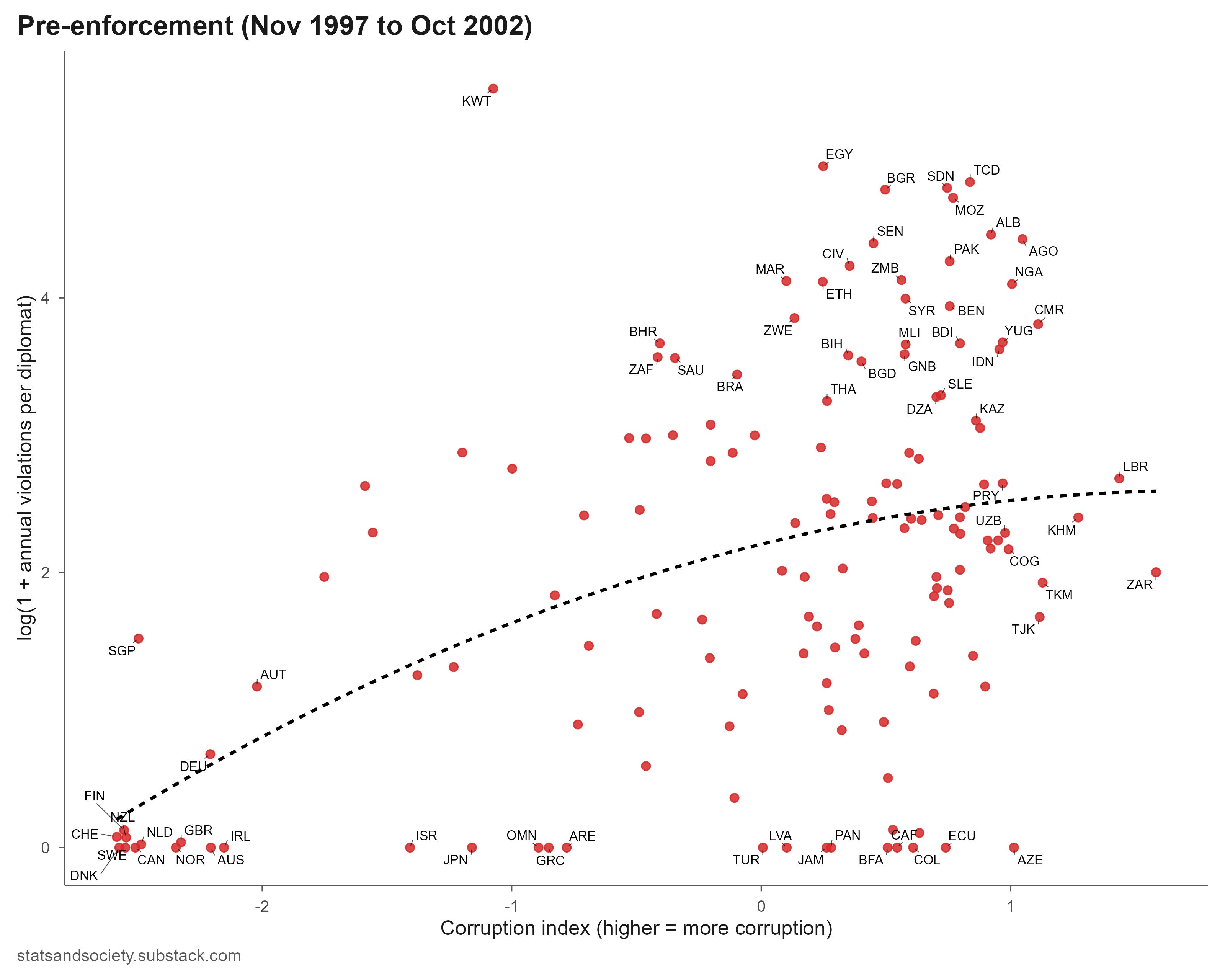
The Cultures of Corruption paper is typically presented as follows: some UN diplomats are from countries with low corruption (like Sweden), others from those where corruption is endemic (like Egypt). When they were stationed in New York City in the early 2000s, they were – due to diplomatic immunity – completely free to act as they pleased (for instance, in accordance with norms from their own culture). What happened is that diplomats from low-corruption cultures were not acting in corrupt ways, while the other ones were. Specifically, diplomats from low-corruption cultures didn’t generate many parking violations, while the rest were busy accumulating unpaid parking tickets. Enforcement was nonexistent, so their socialized attitudes were free to reveal themselves.
Swedish diplomats ostensibly embodied a culture where corruption is an absolute no-no, so they continued acting this way (in a different society) even when nobody would be able to punish them. Egyptian diplomats exemplified the opposite. In terms of raw numbers, Swedish diplomats accumulated 0 parking ticket violations per diplomat, while Egyptians had around 140. The “effect” (correlation) persisted even when controlling for a bunch of obviously relevant stuff, like levels of development and so on.
The magnitude of the controlled relationship is moderately large: unpaid violations increase by almost 80% when you go up by 1 corruption point. To get a sense of scale, the whole range of country-level corruption in the data goes from around -2.5 to +1.5.
Here’s a bivariate scatterplot that helps get this across.
What happens when enforcement suddenly switches on?
Now, that’s something, and it’s true that a part of the study covers precisely what’s described above. But there’s much more to it.
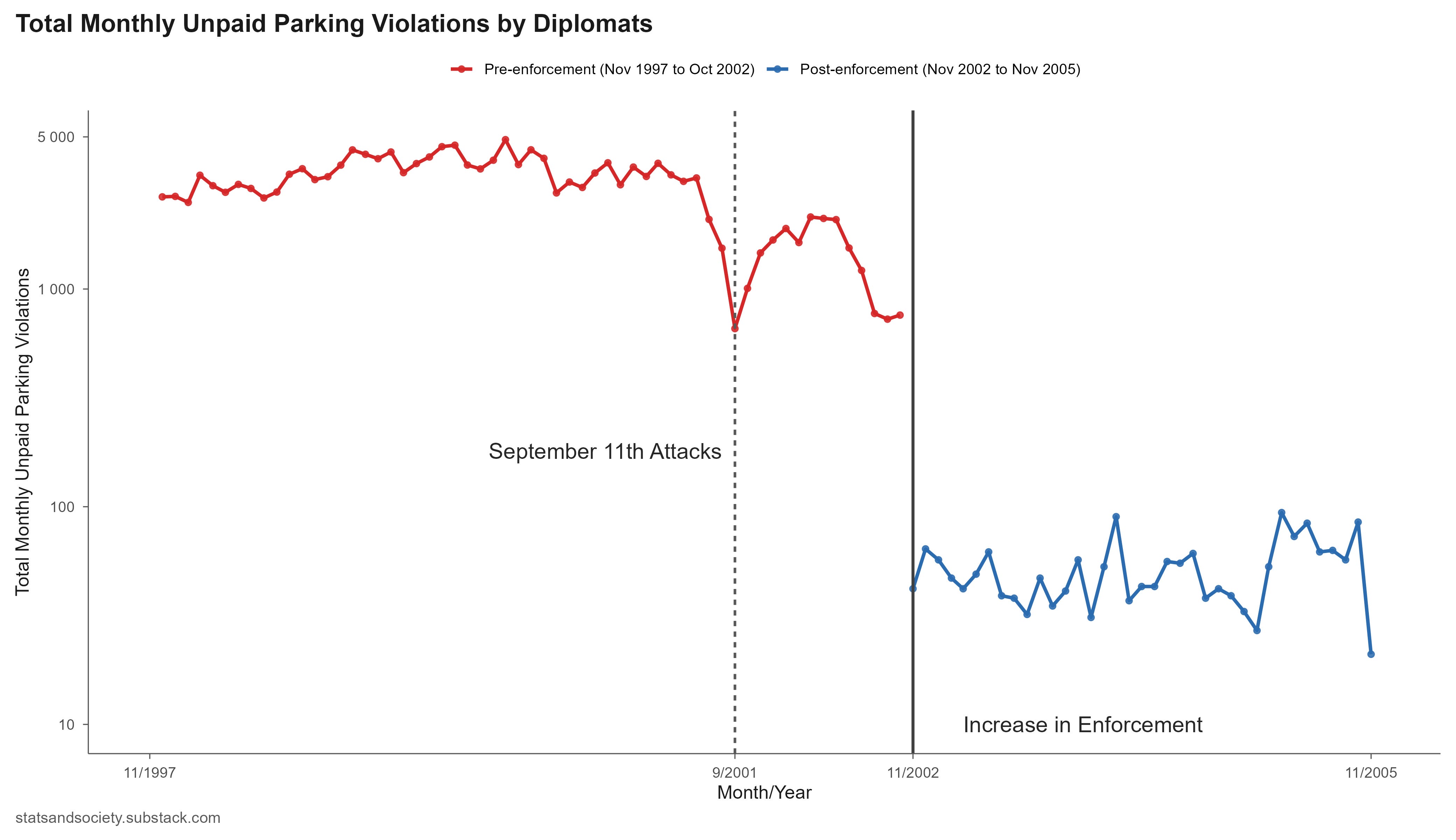
That’s because data are available for the period before any enforcement existed and a later period where there was a crackdown and “diplomatic immunity” no longer applied in a crucial sense. The pre-period refers to roughly late 1997 through October 2002, when unpaid tickets were largely consequence-free. The post-period begins in November 2002, when New York City changed enforcement by sanctioning repeat offenders, most notably by towing or seizing diplomatic plates for vehicles with multiple unpaid violations.
Here’s where my ears perk up. This institutional shock should help create a clear before/after contrast that helps separate the role of baseline norms from the role of material incentives.
In other words, though I’m leaning materialist, I have no trouble accepting that whatever beliefs you might have, you’ll act on those beliefs when (virtually) nothing is at stake. If a diplomat believes it’s really wrong to park at the public’s expense even if you as a politician are able to do it and get away with it, they likely won’t do that. If a diplomat believes it’s okay to park at the public’s expense, they are more likely to do it - as long as you’re not being sanctioned for doing it. Because parking behavior is not an example of a social phenomenon that would be particularly costly or beneficial for a person (at least a diplomat), you just go with the cultural heuristic you’re used to and that’s it.
However, my materialist bet would be that even a person from a low-corruption country like Sweden would quite gladly break their own norm and act in corrupt ways if a lot was at stake. Similarly, even a person from a high-corruption country like Egypt would think twice and probably act in pro-social, non-corrupt ways if a lot was at stake (like a swift and strong punishment for a violation). In my view, cultural attitudes are quite flexible and subject to change when there’s enforcement, punishment, costliness, or a promise of substantial gain. Hence why I don’t typically worry about culture too much.
The study’s results are very interesting from that perspective. First, in line with my materialist leanings, after enforcement came into play and diplomats were no longer free to indulge their beliefs but had to pay attention to how costly their actions might potentially be for them, acting in corrupt ways utterly collapsed. Literally, parking violations declined by around 98-99% for everyone! A clear win for materialism. Here’s the time-series, and mind the logged y-axis.
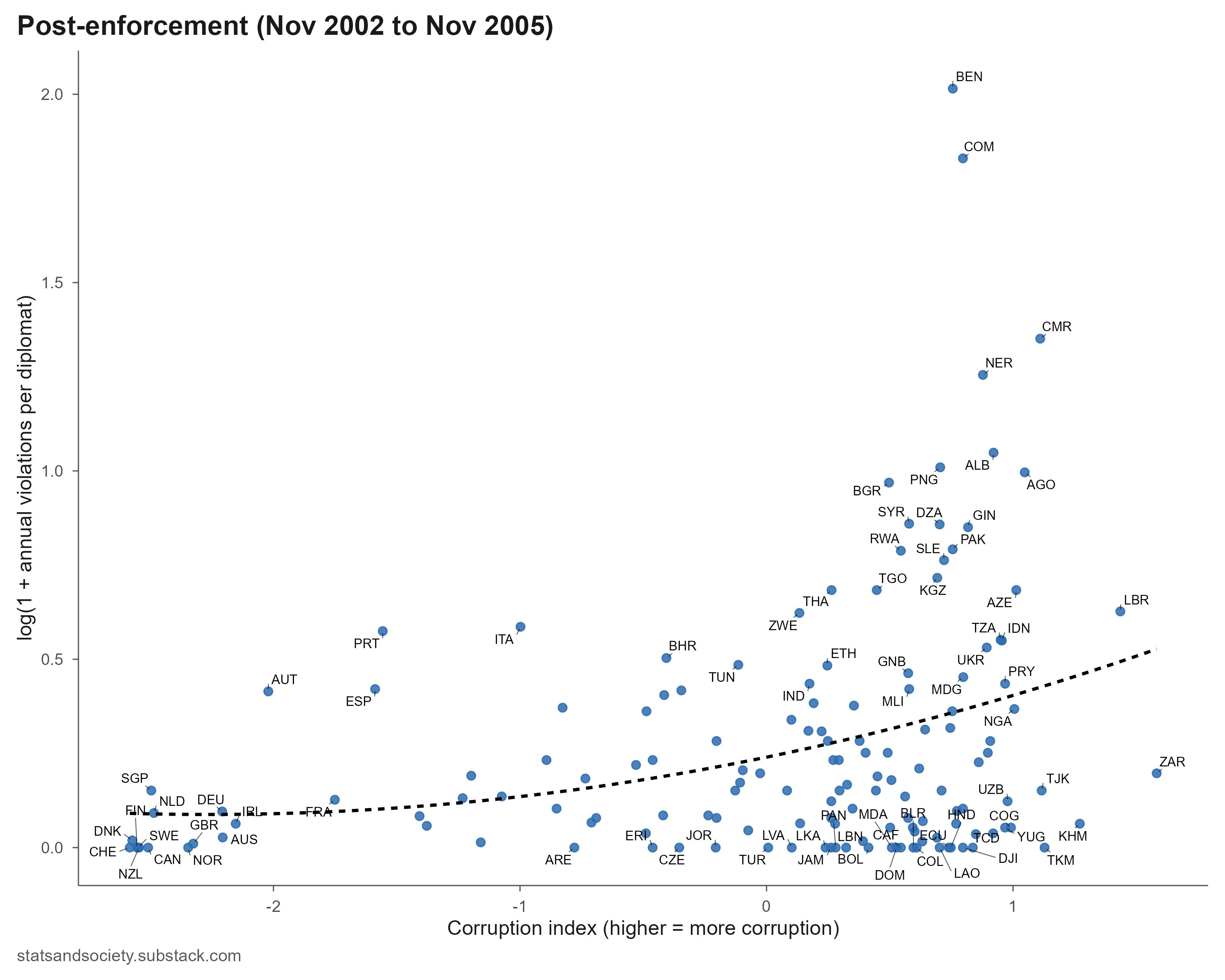
But here’s the second result. Even though parking violations collapsed in absolute terms, “the culture of corruption” still positively predicted parking violations in the post-enforcement period (roughly as strongly). Corruption seems to be sticky, even in the face of clear incentives to the contrary. Diplomats from more corrupt countries, even now as incentives made their behavior costly, were more likely to continue to offend in relative terms. A clear loss for materialism. See the scatter below (controlled models show virtually the same strength of the association as before).
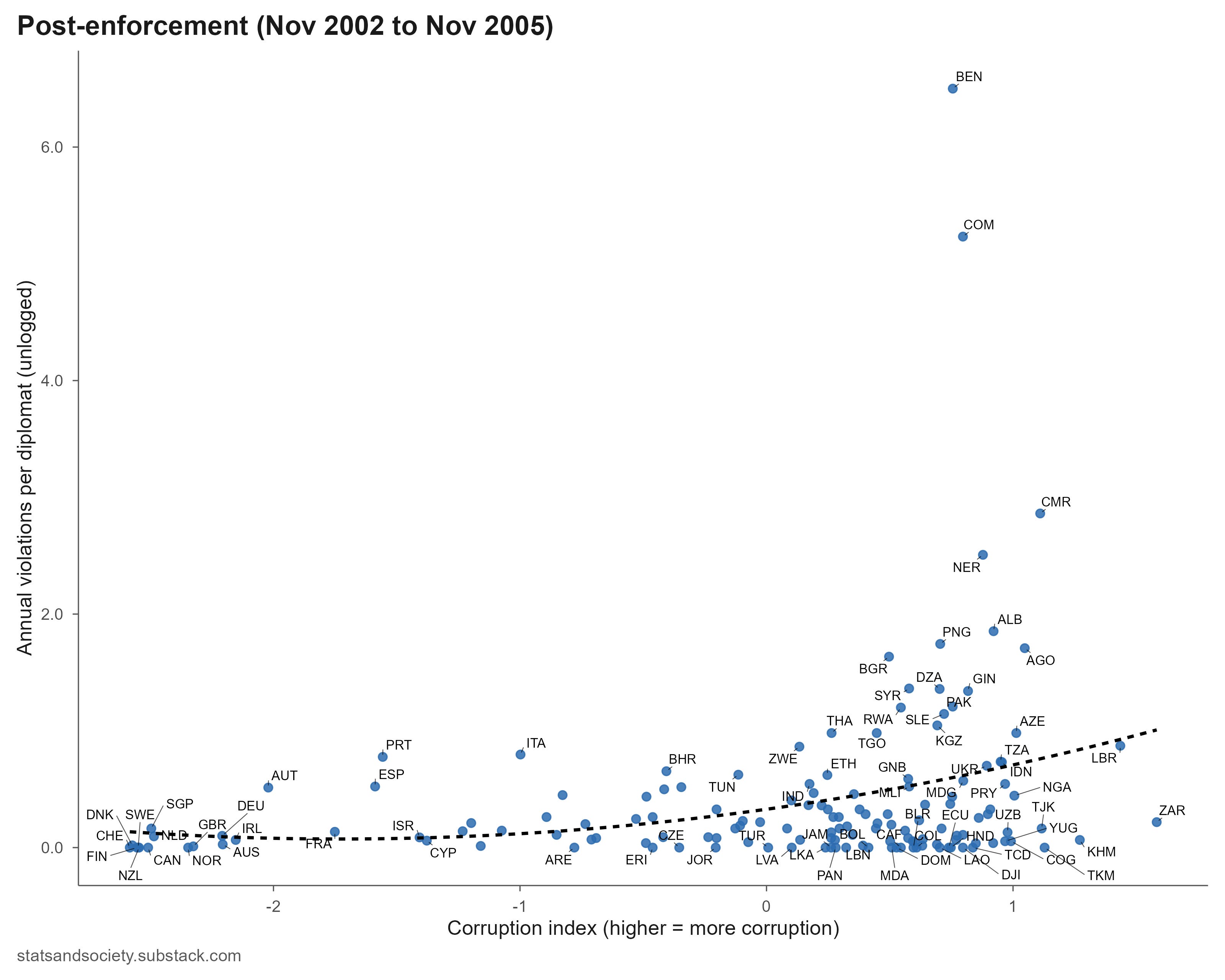
Without doing the log transformation, the scatter is less impressive (see below). But the main, controlled result is robust to using either raw or logged values.
Okay, that’s fine, I have my big boy pants on, I can take it. As a sociologist, I’m quite aware of the proposition that culture matters, and that it does so in the sense of having independent causal powers. I’m also aware of the Deep Roots literature, where you can find a whole bunch of cultural papers with strong identification and actual causal inference. So far, those have moved me away from materialism the most.
Culture really does matter sometimes; though, as I’ve written before:
Protestantism didn’t lead to capitalism or help with development,
and workers don’t stay quiet in capitalism due to ideological/cultural hegemony, to give just a few examples where sociologists and economists were too quick on the trigger.
This corruption thing might be one of the examples of culture mattering, though of course the paper we’re discussing is potentially plagued by endogeneity and thus isn’t apt for causal inference. These are just associations.
But does it replicate?
In any case, one obvious follow-up question is whether the paper (even in correlational terms) is any good. For starters, does it replicate?
I did find a narrow replication from 2017. So that’s good to know. And, in more substantive, less narrow terms, there’s an unpublished pre-print from 2019, exploiting data from Washington DC and parking violations, which finds a similar result. Weird that the study never got published in a proper peer-reviewed outlet, but okay.
I did perform an additional little analysis of my own with the original data from Cultures of Corruption, checking to see whether the result replicates substantively (not just narrowly) with a different measure of corruption and thing closely related to it. I plugged in the V-Dem political corruption and clientelism variables and managed to almost fully preserve the sample. Here, the coefficient size in the post-enforcement period shrinks quite substantially, meaning that (at least in the post-period), the culture of corruption only weakly predicts corrupt behavior. Also, in terms of statistical significance, it verges on non-significant in the case of clientelism and turns non-significant in the case of political corruption. See the figure below, which compares pre- and post- periods for different specifications, including the original result from the paper (in red).
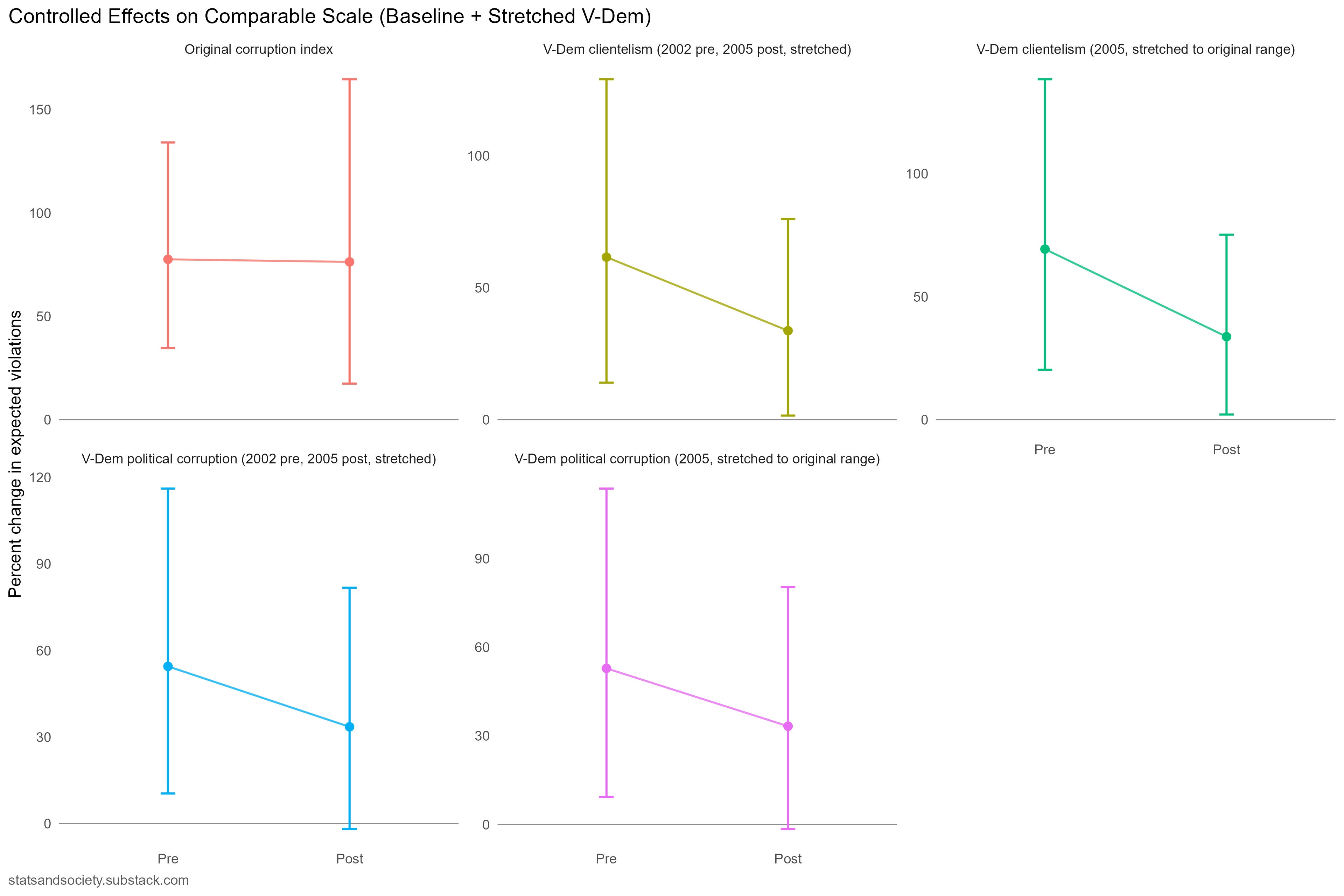
Inspired by the 2019 unpublished paper, which leaned on rule of law instead of corruption, I redid the exercise with the rule of law index (V-Dem) as well. I’m not plotting it here, but in the post-enforcement period the relationship is now gone, tuning non-significant (like with political corruption).
I’m not saying these simple exercises destroy the paper’s finding, but they do give me at least a bit of pause. There are also several interesting additional papers I’d like to discuss in a future post. Some explicitly find that host-country institutions and experiences are much more important than origin-country culture in determining migrants’ behavior. Others specifically show that migrants who experience high corruption before migrating then exhibit higher trust when faced with functioning political institutions in the host country. But perhaps I’m just trying to justify my biases now and cherry-picking, so let me stop.
Materialism has some answering to do, sure, but I wouldn’t quite count it out just yet.
Fantastic piece, Tibor, as usual.
You call yourself a materialist, what do you mean by that exactly?
what do you think of the argument that different countries are selecting for diplomats with different traits?