
Is capitalist core exploiting the periphery, or is it just Deep Roots?
On the latest Hickel paper and the rich-poor gap

Between around 1995 and the late 2010s, a wonderful and never before seen thing was happening. These hyper-globalization years saw substantial economic convergence between the developed and developing world. As is usually the case, most everyone was growing in absolute terms, but now most everyone outside the developed world was also growing so fast that they were actually closing the relative distance with the developed world. And this was not the case because wealthy countries’ growth slowed down but because the poor ones’ rate was so incredibly fast.
The Marxist world-systems theory was contradicted by the empirical facts in that period. The theory doesn’t preclude any one peripheral (i.e., developing) country sometimes catching up a bit, but it does say general catching-up is either impossible or highly unlikely. The hyper-globalization years demonstrated this is much too pessimistic. True, when there was less trade and economic freedom in the world (like in the initial protectionist decades of the post-war period), convergence was not at all happening. The gap between the rich and the poor was instead just growing and growing. But as the Soviet experiment collapsed, as China and India liberalized, and as more economic openness and market integration swept the world, the poor finally started outpacing the rich, world-systems theory be damned. Here’s the famous convergence graph by Sandefur and Subramanian.
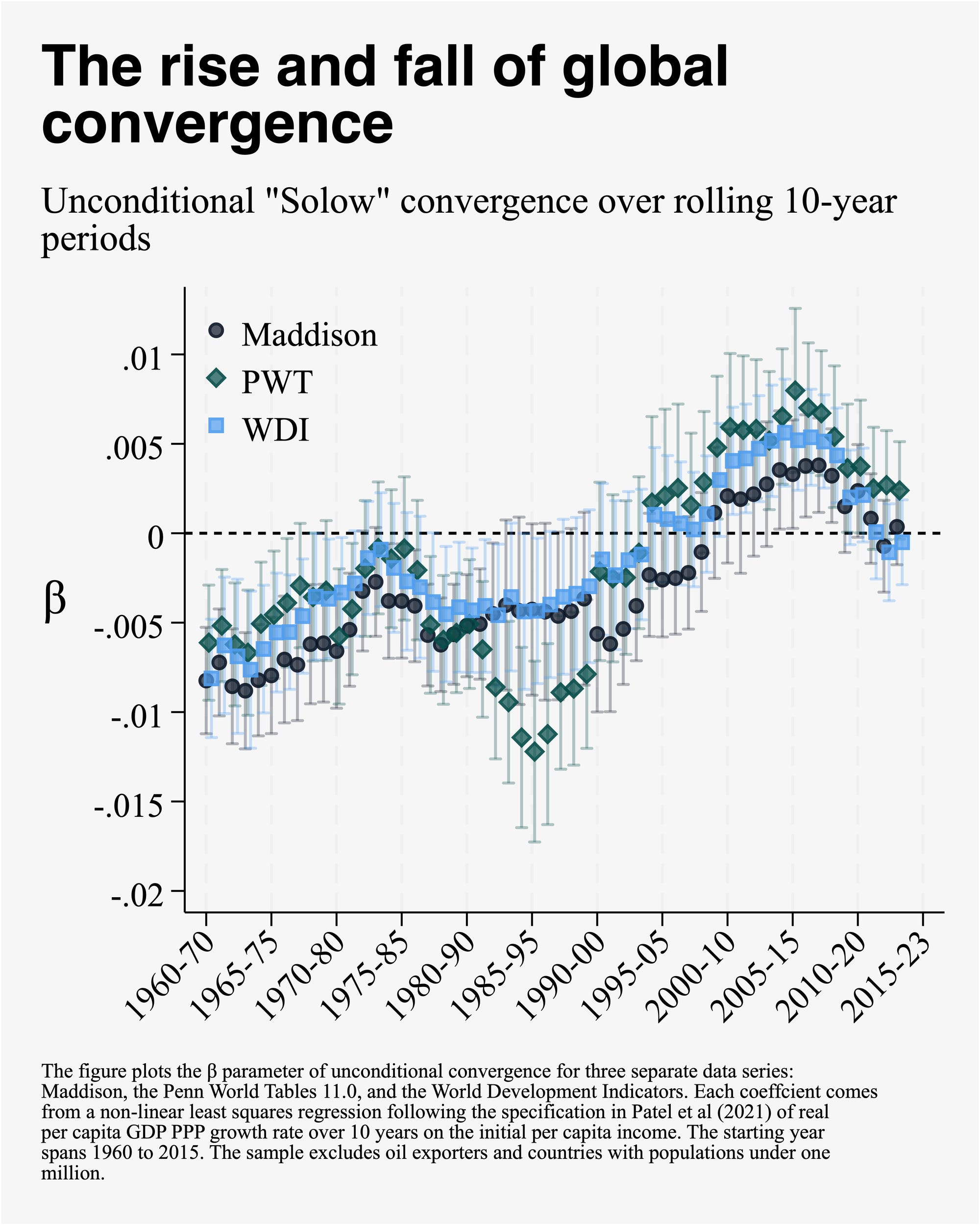
Unfortunately, as you can see, convergence is coming to a close.
In a new paper, Jason Hickel and Dylan Sullivan go one step further and call catch-up development a “myth.” As they say:
Even in relative terms, convergence is not occurring; for most regions and most countries in the periphery their relative position vis-à-vis the core has deteriorated. Core–periphery inequality worsened particularly during the period of market liberalisation in the 1980s and 1990s. … While some peripheral countries have been integrated into the core for geopolitical reasons, an increasing majority of the world population is peripheralised.
These results support the insights of world-systems analysts who argue that convergence is unlikely to occur within the existing structure of the capitalist world economy. Real development in the South will require strategies of industrial policy and planning to increase economic sovereignty, develop South-South trade, and delink from the imperial core.
Lots could be said about this framing. As I’ve already pointed out, there exists a substantial period of time when convergence was happening. If you look at WDI data on GDP per capita, you can easily see that the periphery-core ratio rose from 11.5% in 1990 to 23.7% in 2023. Excluding China (though why would you exclude it?), the ratio rose from 14.4% to 20.4%. If you use Maddison or PWT data, you get similar results. At the country level, 63 of 106 peripheral countries improved their relative position, while world-systems predicts no general improvement or even additionally widening gaps.
Contra Hickel and Sullivan, this convergence period started precisely after economic freedom significantly improved around the world. In 1975, 1980, and 1985, the global combined score for size of government, freedom of international trade, and regulation was treading water at around 5.3 (down from 5.7 in 1970). The score then skyrocketed during the 1990s to 6.7 in 2000 (out of 10). Unprecedented convergence began in the mid-1990s. Of course, this is just an association, but we also have plausibly causal evidence that liberalization helps with development.
Coincidentally, the era of unconditional convergence is coming to a close just as the neoliberal system is crumbling and talk of de-globalization is omnipresent (to the perverse delight of many on both the right and left).
Finally, it’s too dismissive and ideologically convenient to characterize the 18 former peripheral states that have become part of the core as simply “some peripheral countries,” which “have been integrated into the core for geopolitical reasons.” And so on.
But let’s leave that aside. Let’s grant that economic convergence has mostly not been happening, or that it’s been very slow. Is it true, as Hickel and Sullivan claim, that this then “supports” world-systems theory? It’s clearly consistent with it; but does it actively support it, rule in favor of it? That is, if there’s been virtually no convergence, does it follow that this is so because the core is consciously underdeveloping, and appropriating surplus from or exploiting and plundering, the periphery?
An alternative explanation: historical path dependency
I think not. One interesting alternative explanation, which is also pessimistic but in a different way, concerns the Deep Roots of development. This strand of literature claims that countries and populations which entered the modern period with different productive capacities might remain on persistently different developmental trajectories – even in the complete absence of any international appropriation and contemporary unequal exchange.
There seem to exist persistent historical differences in geography (obviously) but also technology, state formation, agricultural development, human capital, and just culture in general (kin-based vs. non-kin based, for instance).
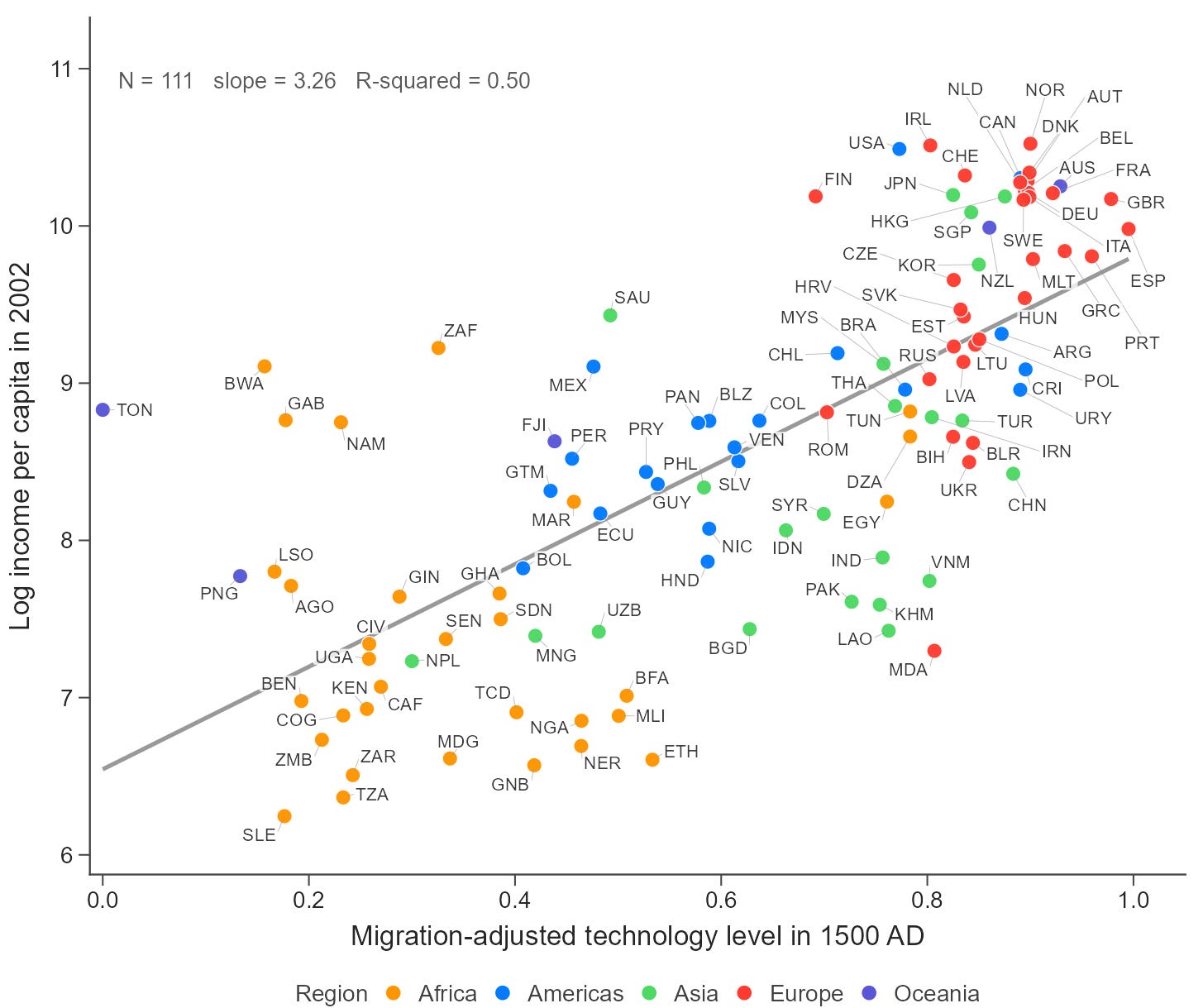
Probably the most relevant for present purposes is the Comin et al. (2010) study. They construct measures of technology adoption in 1000 BC, 0 AD, and 1500 AD and relate them to contemporary technology and income. As folks might remember from the various Garett Jones debates (including, if I remember correctly, the two Caplan-Jones discussions), Comin and colleagues use a migration-adjusted measure that assigns historical technology according to the ancestral origins of a country’s present population. They find that migration-adjusted technology in 1500 is strongly associated with income in 2002 and accounts for a substantial portion of its cross-country variation, net of many controls. Their results for 1000 BC and 0 AD also become stronger after making this ancestry adjustment, although the 1500 measure remains the key result.
Here’s my remade version of Comin et al.’s key scatterplot (their journal-ready, published version is surprisingly ugly and unreadable).
Now, ideologically, I don’t want this to be true. This is partly for idiosyncratic personal reasons of mine but also just because we would obviously want the world to be a place where poor countries could quickly get out of poverty and significantly develop through, say, applying just a few fixes to their institutions. We wouldn’t want history to be tending toward the deterministic and inflexible. Instead, we’d want to say to the developing world: just adopt good institutions like open international trade, slash subsidies and inefficient regulations, and educate the population – and you’re on your way to the top!
But perhaps history really is much more path dependent. Sure, good institutions are a key part of the story, but maybe it’s much more difficult for them to truly spread across the world, and they’re probably just one part of the story.
In any case, the point is that the slow overall pace of convergence could very well be due to Deep Roots. If measures recorded before the formation of the modern capitalist world economy predict a considerable amount of contemporary development, it’s difficult to argue that the present hierarchy was created entirely after the 16th century. Some relevant differences evidently preceded European colonial expansion and the modern international division of labor.
Could also be both. Pre-modern technological and political differences could have influenced which societies acquired the capacity to project military power and establish colonies. The development of the capitalist world economy could then have amplified those earlier differences. Or it could be neither. Hickel and Sullivan move too quickly when they seize only on the world-systems side of the ledger to explain non-convergence.
The spatial fragility, and robustness, of Deep Roots
But there’s one potential problem for the Deep Roots explanation, which is important and interesting in itself. Conley and Kelly (2025) have examined a large group of Deep Roots/persistence studies and argue that conventional cross-country regressions, which are typically employed in this literature, often mistake spatial patterns for independent observations, which is very problematic for the validity of their statistical inference.
The potential problem is this: historical technologies (or geography, institutions, and so on) and present income are all spatially autocorrelated. Countries close to one another tend to resemble one another, so standard errors that treat them as largely independent can be much too small. In other words, statistically significant results (coefficients with a small p value) could very well be artificially inflated and non-significant in actuality.
This is exactly what seems to be the case. Across 30 influential, even famous Deep Roots/persistence studies they reanalyze, only a few results remain conventionally significant under their more demanding procedures for addressing spatial autocorrelation. And you guessed it, Comin et al. (2010) is one of the main victims.
In the Comin specification reported by Conley and Kelly, the original nominal p-value is 0.002, which is very nice. But after adding a simple spatial trend, which is one way to test robustness, it becomes 0.829. See figure below, though note that the row is mislabeled. The result concerns Comin, 1500 AD (not Comin, 1000 BC). The replication code makes it clear that they’ve just mislabeled the row.
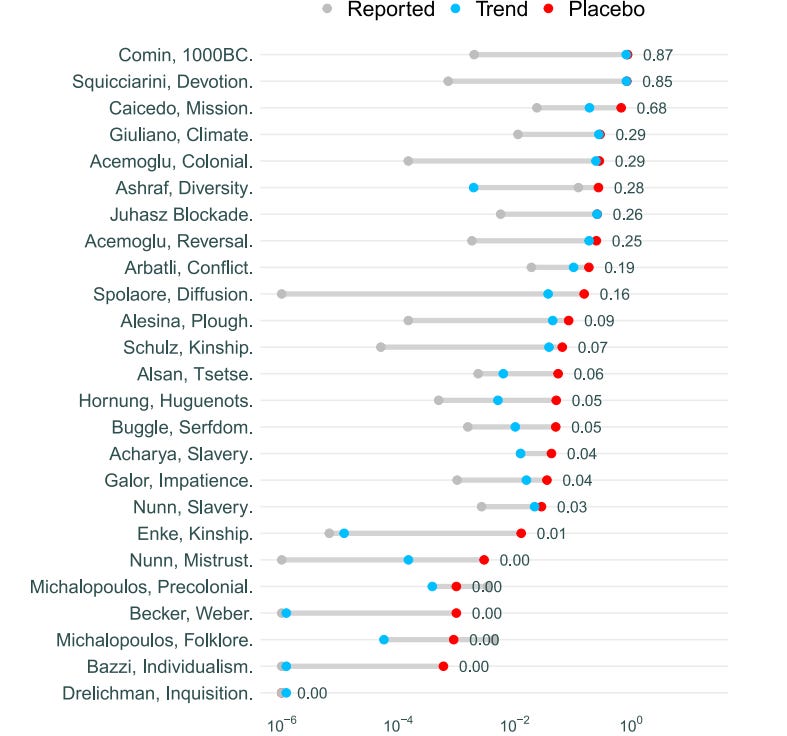
In their spatial-basis regression, the coefficient remains marginally significant with an ordinary heteroskedasticity-robust standard error, but the associated placebo exercises indicate that this procedure over-rejects, so it’s not really informative. With their preferred large-cluster inference, the p-value is 0.23. Again, not significant.
However, and bear with me here just a bit more, the Comin et al. result scrutinized by Conley and Kelly corresponds to the place-based specification in Comin and colleagues’ Table 8A, not the stronger migration-adjusted specification in Table 8B. In other words, Conley and Kelly simply didn’t test the most relevant Comin et al. result! But I did.
When I tested the key Comin et al. result to see if it’s robust to spatial dependence (and yes, I freely admit I did so in hopes of seeing it crumble), I found that it is. I threw virtually everything Conley and Kelly suggest at it, but the migration-adjusted 1500 AD technology result remains significant across the vast majority of tests. When spatial controls and large geographic-cluster inference are introduced, the coefficient was positive every time, and significant at the standard 5% significance threshold in 29 of the 30 different specifications I ran.
I also carried out the recommended simulation diagnostics. These ask whether (1) we would get similar results if we replaced the historical technology variable with fake spatially patterned noise, and (2) if the modern income pattern could itself be generated by spatial trend plus spatial noise. The first test is easily passed, while the second is more uneven: at the 5% threshold, only about half of the targeted specifications pass all diagnostics (though at the 10% threshold they all do). That’s pretty okay.
All this to say we should be careful how we interpret persistent developmental differences between countries (outside the precious and special temporary periods where these shrink notably). You can’t just look at non-convergence between core and periphery and attribute it to “the core siphoning off surplus from the periphery.” There are multiple competing explanations for the persistent rich-poor gap. I also have to admit it’s a bit funny to me to imagine that the “new core” countries such as, say, Malta, Taiwan, Slovenia, Estonia, Cyprus, or Singapore are somehow ripping off African economies, as if that’s how they became rich.
Nice. Do want to note one thing though because it's kind of pet peeve. Economic theory predicts *conditional* convergence not absolute convergence which is believe is what you have in your graph. Absolute convergence may have come and gone and come and gone, but conditional convergence has more or less always been true, regardless of time period. It never went away.
Of course one can argue that at some point the "conditionals" are doing so much of the work that the distinction becomes meaningless, particularly when youre talking about abstract things like "quality of institutions". But even adding something fairly basic like investment rate gets you conditional convergence almost everywhere all the time
Very interesting article. I've recently been toying with an idea of path dependence when it comes to deliberation publics, and had an inkling that this could be applied to countries and institutions more broadly. It's nice to see that lots of that research seems to be well under way and seems to validate my thoughts!
I wrote an essay on an explanatory (as opposed to statistical) hypothesis/framework for how this path dependence might work if you are interested.