
Economic misperception helps explain populism
When the well-off feel left behind

Many folks are still trying their darndest to be charitable to populist voters and assume there must be some significant objective (or even justified) economic grievance these citizens have that explains why they’d vote for reprehensible political options like the German AfD or Donald Trump.
In doing so, I’m afraid sometimes the aim is simply to support your own pet theory of what’s wrong with the world. Suppose you hate capitalism or the Western world more generally. The fundamental issue you have is that it’s hard to point to a convincing metric which would makes sense of your hatred. Capitalism and Western societies score high on virtually every conceivable social measure, so that won’t work. But perhaps you could point to a social phenomenon universally reviled by liberals, like the rise of populism and the far-right over recent decades, and say that capitalism or Western societies are clearly pathological at least in the sense that they spawned this unfortunate event. You could even claim that there’s clearly something deeply and objectively wrong with these societies, which is ostensibly why increasing shares of (rational, perceptive) voters are rebelling against them by electing populists. Check-mate, liberals!
I don’t buy this particular move, for many reasons. Moreover, my general materialist charitability (= people’s attitudes and behaviors generally reflect the real happenings and incentives in their surrounding environment) is, for good or ill, wearing increasingly thin when it comes to voters, especially populist ones.
This is so in part because there’s a lot of research showing any straightforward materialist explanation for the rise of populism is either wrong or highly mixed in terms of the evidence we have for it. I’ve written about how many studies fail to support the inequality thesis for the rise of populism, and how not only national but also regional inequality doesn’t seem to matter. I also reviewed a causal meta-analysis, which reveals only mixed evidence that import exposure (globalization) and objective labor-market exposure have anything to do with populism, and additionally reveals that there’s overall lots of publication bias. Once publication bias is corrected for, the average partial correlation coefficient on measures of economic hardship shrinks by more than 70%. Pundits should start updating on this.
The same meta-analysis suggests that subjective economic hardship stands out as a more robust cause of populism. That makes a lot of sense to me, given everything else we know about widespread voter ignorance and social media-driven moral panics. For various (non-objective) reasons, many people have the mistaken impression that their world is falling apart, economically, which is why they’re frustrated, which in turn is why they are throwing their lot in with the populists. At least that’s my speculation.
As Kevin Bryan puts it in a related context:
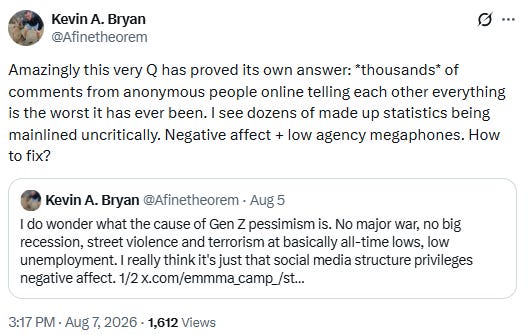
Actual inequality doesn’t matter, but inequality misperceptions do
So, instead of only (or primarily) looking at how reality ostensibly forces rational people to vote for populists, we should also be investigating how irrational people’s misperceptions about the world make them vote for populists. Here’s a quick economic illustration of this very fact.
Statistically, I’m unable to predict from actual inequality which European countries’ voters are more or less attracted to populists. But I have no problem predicting populist voting based on perceived inequality. See below.
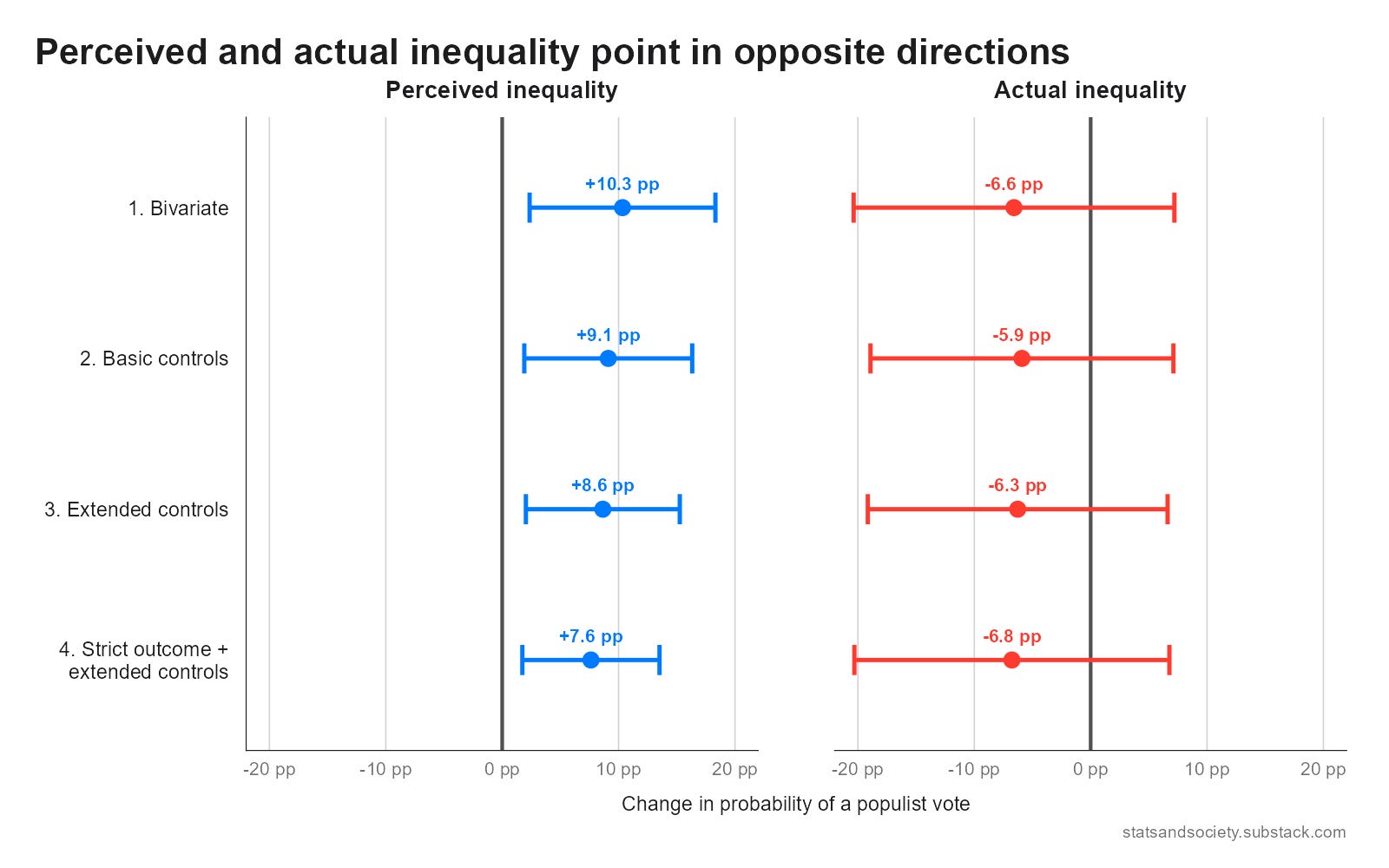
I used a recent ISSP module on inequality to construct a country-level Gini measure of perceived inequality, inspired by this paper, and relied on the latest ESS wave for individual-level data on populist voting. Importantly, it turns out that actual and perceived inequality show no statistically significant correlation with each other. That is, people think inequality is high or low in their country regardless of whether it’s in fact high or low! Misperception.
As you can see in the coefficient plot, I try to mess with the data in different ways, but the results stay the same. Now, this is just illustrative and correlational, and I don’t intend for it to be taken too seriously. However, just the other day, a much more serious preprint was published on the topic of relative income misperception and populist attitudes. It links up nicely with, and significantly boosts, what I have argued and presented so far.
When the well-off feel left behind
Thilo Albers and colleagues ask why people who are doing perfectly well economically sometimes behave politically as though they’ve been screwed over. To answer the question, they use German survey data in which they observe both a household’s actual position in the national income distribution and where respondents think they rank. As you’d figure, people are not especially good at locating themselves. Folks toward the bottom tend to imagine themselves further up, while those toward the top think they’re much closer to the middle. A substantial number of affluent Germans are walking around under the mistaken impression that they are considerably less affluent than they really are.
I doubt this is only true in Germany; just think of how most Americans really live and how different the economic nonsense they say on X is.
In any case, what the authors find is that, when holding people’s true income position constant, respondents who underestimate their relative standing express more populist attitudes. The relationship isn’t particularly large, but it’s notable: a 25-percentile-point underestimate of one’s rank (which represents about a 1 standard deviation in the sample) is associated with roughly 0.15 standard deviations more populist sentiment. Not a large relationship, but it’s very robust and even potentially causal in one of their approaches.
Also important is the fact that the relationship is asymmetric. That is, people who falsely believe they are poorer than they really are tend to be more populist, but erroneously believing yourself richer doesn’t produce an equivalent movement away from populism! Makes total sense and goes to show that this is not just about being generally bad at estimating. See the coefficients on “Misperception” below in the total sample and the subsamples.
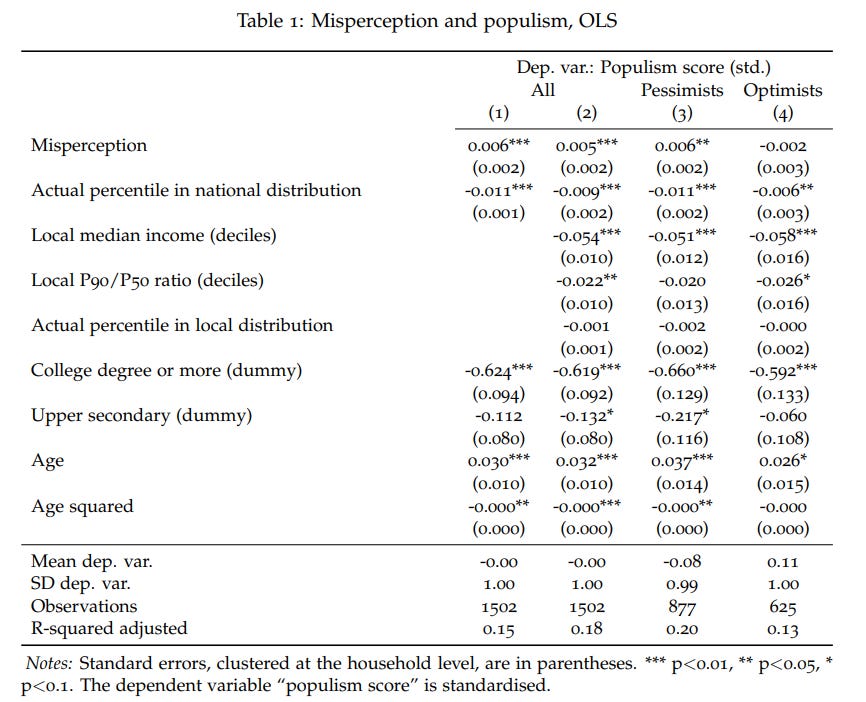
What are some other things we can read off this regression table? There are a few that make me secure in my increasing skepticism about materialist explanations for populism, but there are also some results that push against it. I don’t want to wave those away.
First, higher local inequality (Local P90/P50) doesn’t predict more populism. If anything, it does the reverse! More locally unequal contexts see less widespread populist attitudes. Additionally and somewhat relatedly, how locally poor or rich you are (in relative terms) doesn’t matter at all.
Second, however, where you are in the income distribution nationally does seem to matter. The richer you are, the less you are attracted to populism, holding all else (including misperception) constant. At first glance, this even seems to matter more than misperceptions - the coefficient in, say, column 2 is higher for the actual percentile compared to misperception. But for that to be informative, the original decomposition has to be recovered, which shows that both are of comparable size.
Fair enough, income misperception and reality might both matter in this case. (See also the coefficient on local median income.)
An additional neat and somewhat ironic fact about the analysis and the data is that the respondents who underestimated their income rank were, descriptively speaking, the more economically comfortable group. See below. On the right-hand side are the “pessimists”, or citizens who think they’re doing worse than they actually are. If you compare them to the “optimists” (people who are also misguided but in the other direction), these pessimists aren’t just doing better than they think they are but are also overall the better-off group. They have more income, are more likely to own their homes, have savings accounts, be employed full time, and even hold financial investments.
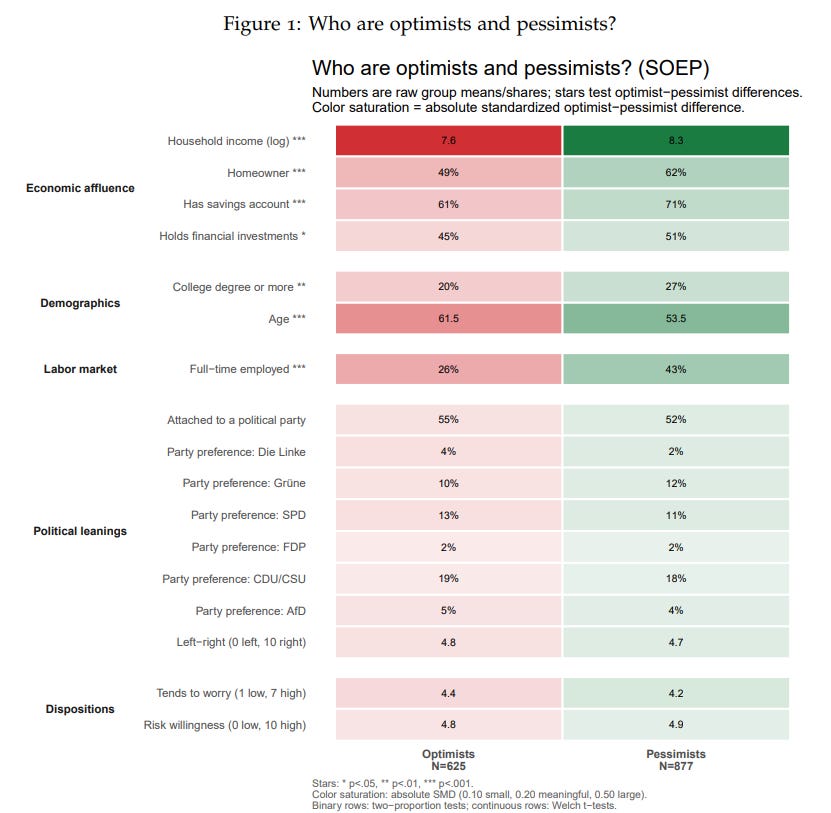
This is how the authors summarize these funny descriptive differences:
pessimistic misperception is common among economically secure respondents and is not obviously reducible to prior far-right identification, prior anti-establishment attachments, or a generalized pessimistic disposition.
The other interesting part of the study has to do with an experiment they ran. The authors wanted to see what happens when citizens are informed of the truth about their income positioning. In a preregistered experiment with roughly 5,000 Germans, respondents were randomly shown where their household really sits in the income distribution. The intervention worked exactly as an information treatment should, in that is that people corrected their beliefs to a notable degree. (Learning that they were better off than they’d thought also produced somewhat greater satisfaction with their income, but this isn’t statistically significant.)
However, correcting people’s economic misconception had essentially zero effect on the populist attitudes they expressed.
So, it seems that false beliefs about one’s material standing are involved in the formation/maintenance of political grievance. But then once that grievance has already been incorporated into a broader populist worldview (i.e., politicians don’t listen to people like me, elites have rigged the system, and so on), probably via social media and simply the political supply of populism, correcting the factual premise does not dissolve the misguided political conclusion. They’re locked in now.
I think you're looking at the wrong statistics here. I think the statistic most relevant to a voter's conversion to populism is not his economic standing relative to the rest of the population, actual or perceived. It's his standing relative to that of his grandfather at the same age.
I'm deliberately using masculine gendered language because most women know that they are better off than their grandmothers were simply because they, as women, have more legal rights and get more respect, even if they're not any better off economically.
I'm a boomer myself and I remember cousins and classmates of mine during the Vietnam War era getting married right out of high school and trying for a baby right away. That's how much economic confidence there was.
The conditions that gave rise to and justified that economic confidence were long-lasting enough to inspire a belief that they were natural, more or less the default, so when conditions worsened, that belief gave rise to a notion that someone had interfered with the natural order. All of populism follows from that notion.
"So, it seems that false beliefs about one’s material standing are involved in the formation/maintenance of political grievance. But then once that grievance has already been incorporated into a broader populist worldview" how do you know the perception of one's standing isn't just downstream of the populist worldview?