
Does democracy really exacerbate homicide?

A recent Richard Hanania piece on violence, Latin America, and democracy reminded me of an interesting paper I read last year in The British Journal of Criminology. Using lots of different democracy data, it argued that there’s a positive relationship, net of confounders, between political freedom and homicide (while economic development helps ameliorate it, as we’ve known for a while now). The paper is not particularly impressive in terms of causal inference, but it does quite a few things in terms of robustness testing and is overall convincing at least in descriptive terms. So, democracy and homicide really do go together?
Hanania was careful to argue that it’s actually Latin American countries which are the biggest outliers. Many of them are relatively democratic and enjoy at least middling levels of development, but they’re also quite violent. Relatedly, it’s more likely that weak state capacity, rather than democracy specifically, is at issue. But still, it’s not just Latin America, and the state capacity point doesn’t get democracy off the hook totally. Most importantly, in authoritarian places violence is simply not that high and is roughly where you’d expect it to be given their level of development. So, in his view, “Democracy is not a sufficient condition for having an unusually violent country, but it does appear to be a necessary one.”
I decided to run a few analyses of my own and look at the existing literature on the topic to see what we can learn about the whole affair. Is democracy (in certain senses at least) really a good predictor of societal violence?
The literature
Perhaps surprisingly, there aren’t that many studies on democracy and homicide, and definitely not many that are good. Here’s a relatively representative sample of what research typically shows.
First, there’s the older research. Neumayer’s 2003 panel study gives the classic “transition problem” result, which Hanania gestured at with his state capacity point. Using data for up to 117 countries from 1980–1997, Neumayer finds that richer countries, economic growth, respect for human rights, and abolition of the death penalty are associated with lower homicide. Democracy looks protective only once it is highly developed. Before that, the dangerous zone is when the initial move happens from autocracy toward democracy. There, homicide may rise. After democratic institutions are fully consolidated, however, this seems to disappear.
But you also have results like Lin’s (2007). Lin asks whether democracy increases crime generally, not just homicide, and his answer is “it depends on the seriousness of the crime.” Across Interpol and victimization data, democracy is associated with less homicide but more lower-level property crime. His interpretation is that democratic governments allocate punishment and enforcement differently: if anything, they appear to preserve stronger deterrence for the gravest crimes while being less punitive toward minor crimes. So this study cuts against the claim that democracy raises homicide.
In 2011, a meta-analysis by Nivette was published, where the conclusion is that democracy is a weak predictor of homicide. The strongest variables are simply being Latin America, income inequality, and welfare protection, while democracy indices sit near the bottom of the ranked predictors and are essentially null on average. One key conclusion is, unsurprisingly, that the field has weak foundations for causal claims because studies often use small, biased country samples, vague proxies, and mostly cross-sectional designs. Okay, so that wasn’t too helpful.
Later studies point somewhat more clearly in the direction of transitional democracy being bad for homicide. I already mentioned the 2025 paper by de Soysa at the beginning. There’s also Chon (2018), who at first shows democracy is associated with lower homicide and higher suicide. He interprets this as democratic societies channeling frustration inward rather than outward, partly because people rely more on law and formal institutions to settle conflict. However, he also finds that a squared democracy term fits better than a simple linear measure, implying that transitional regimes may be more homicide-prone than either full autocracies or full democracies.
A Brookings policy brief (by Piccone, 2017) also synthesizes the literature as mixed but leaning toward the threshold/transitional view. Namely, stable strong democracies and stable strong autocracies tend to have lower homicide, while hybrid or democratizing regimes often have higher homicide.
My relatively brief reading of the (newer) literature is that there is possibly something to the idea that non-consolidated democracies are bad for homicide, which roughly jives with Hanania’s argument.
Not so fast
I wanted to see whether I can recover this alleged effect in a quick synthetic diff-in-diffs analysis, where treatment is defined as late-20th, early-21st century transitions from autocracy to democracy using various measures of democracy, like Polity, V-Dem, Boix-Miller-Rosato, etc. The idea is to compare these fledgling democratizers with similar but non-democratizing societies, both of which experienced the same homicide trends up to the point where one group got treated and the other did not. Hopefully, that allows us to observe the otherwise missing counterfactual, which could tell us what would have happened to the democratizers had they not democratized.
At first glance, or if we’re being very selective, there’s maybe something there. But not really. Here’s the closest I get to identifying a positive effect.
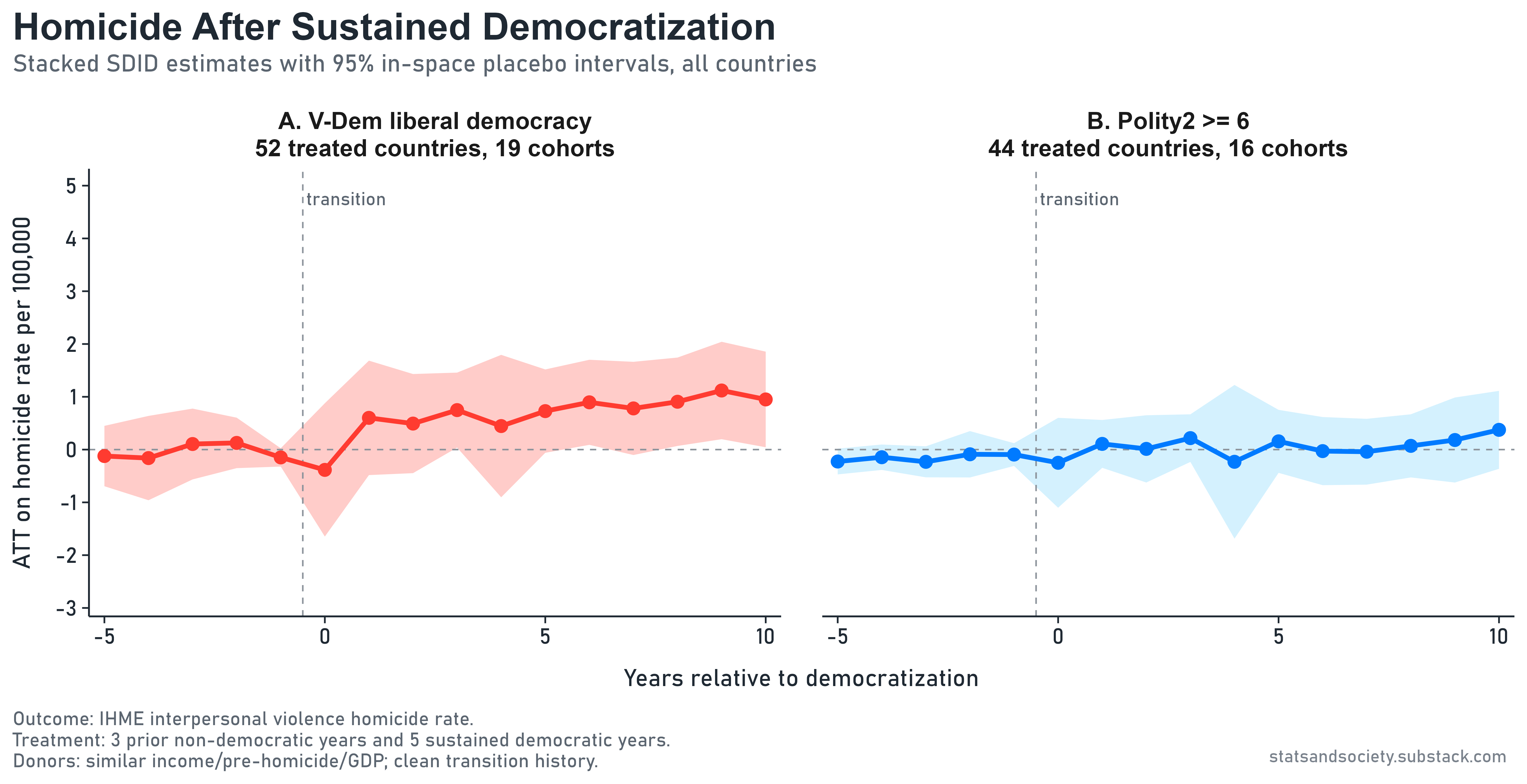
Almost every event-study plot I generate looks like the right-side panel: no effect. Even in the left-side panel, you can see that it takes years after the initial transition to democracy for the alleged positive effect (boosting homicide) to show up, and even then it’s only barely significant under in-space placebo inference. Pre-treatment coefficients are as they should be, virtually null and non-significant, so there are no obvious signs of endogeneity mucking things up. Obviously, that’s very preliminary; you’d need much more (including in-time placebo testing) to see if the design really - well, plausibly - holds up.
Separately, I looked specifically at cases restricted solely to low- and middle-income countries to see if anything shows up there. But it doesn’t. I also additionally operationalized the transition to democracy in a less simplistic way than just seeing whether a country is below or above a fixed numeric threshold for a few years before and after (I tested quite a few of those, by the way). After doing so, I got a nice and relatively small sample of transitioning countries that seem to me to be very good candidates for testing the hypothesis. This below is the narrower sample, and the algorithmically picked dates of the transition fit almost perfectly with what you get from manually looking at historical descriptions/sources and a more qualitative reading.
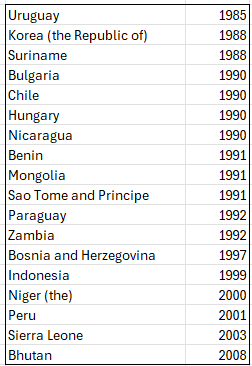
Most of these are not (or were not at the time) known for their strong state capacity or riches either. There’s an exception or two at best, but that’s it. So, any positive effect of democracy on homicide here? In general: no, not really. The ATT is +0.51 but CIs overlap zero (-0.29, +1.25).
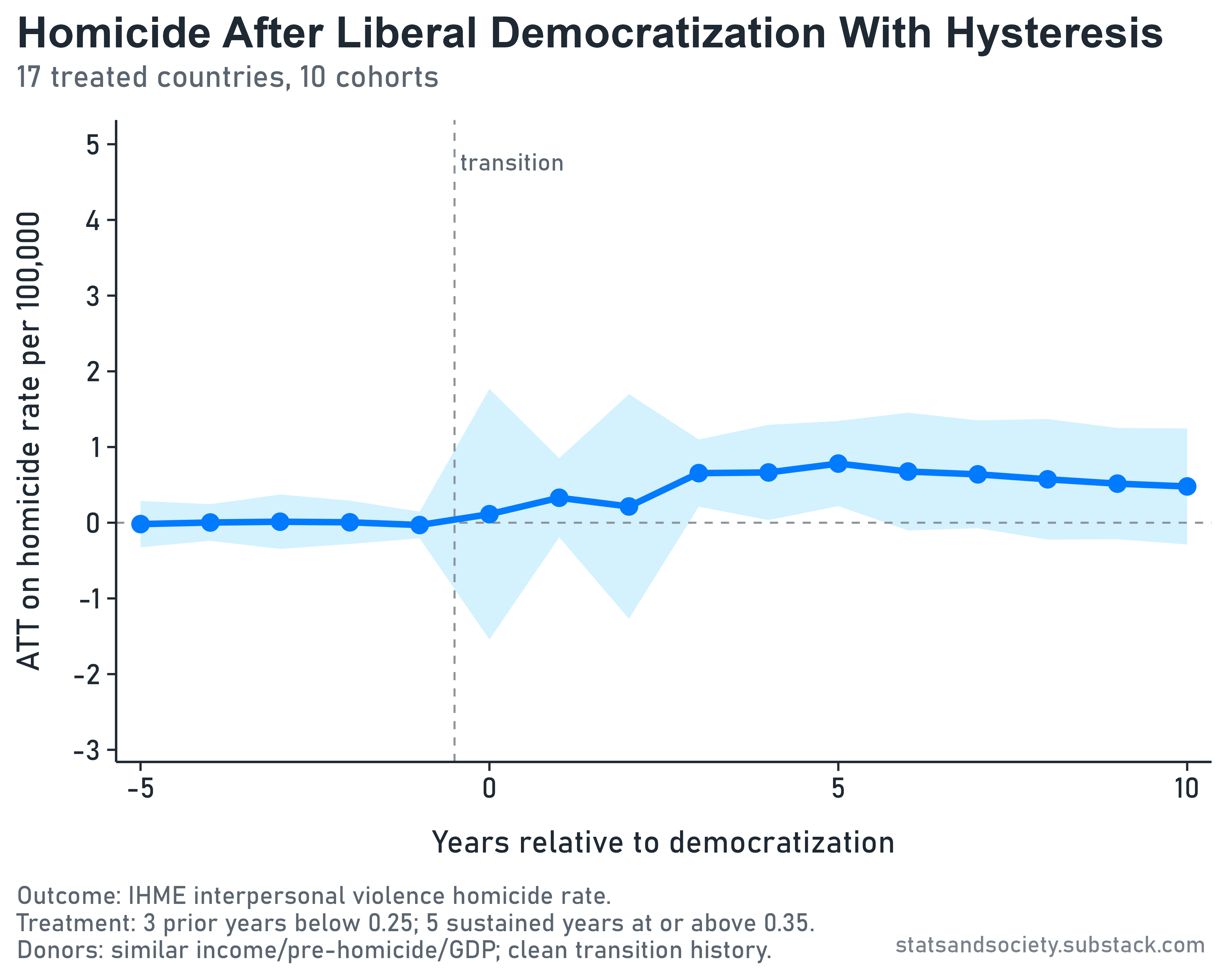
I redid this and the earlier analyses by employing various specification changes, like extending the pre-treatment window and playing around with the donor pool (i.e., using every available country or restricting it to just those that are broadly similar). Things stay virtually unchanged regardless of what I do. I also tried different estimators, such as generalized and augmented synthetic control. Results are very similar: an inkling of a positive effect but nothing significant (regardless of which procedure for statistical uncertainty I use).
So, I’m not sure that transitions to democracy really cause issues with rising homicide in societies. That doesn’t mean there aren’t some cases where democracy (perhaps long after the initial transition) remains coupled with weak state capacity and is unable to consolidate or grow richer, and thus sees more violence. But we really need more (and more credible) research to know for sure whether there is an effect, and what its magnitude might be.
I'm not sure about the idea of looking at transitions to democracy worldwide. Late twentieth, early twenty-first century has a lot of Eastern European nations in the sample. It seems that Europe has just figured out how to control violence. Whatever their circumstances, people of European and East Asian descent just don't commit a lot of crime anywhere. I think the best evidence is qualitative. We know Latin America gives a lot of rights to criminals, and has a lot of violence. Again, democracy is necessary but not sufficient. Its might not even have any predictive value at all outside Latin America, Africa, and the Caribbean.
Interesting discussion, my own takeaway from what you said so far is that the research on this topic is kind of limited and not very great right now, so we should be sceptical and agnostic about the issue right now. Even so I wonder what the effect of transitions to autocracy is even if it turns out that transitions to democracy are bad in the short term. I’m not seeing anything in those papers that distinguish between this possibility and the possibility that governments in transitions are not very stable or good at maintaining law and order. Would be interesting to see what happens if you look at hybrid countries drifting towards autocracy. El Salvador is a counter example, obviously, but that’s like one example, although of course I already said, we should be pretty doubtful about the story where changes in the level of democracy, have any effect on this, and even if the effect is real, I expect it’s pretty small or it wouldn’t be this hard to tell.