

Decades ago, during the heady days of “modernization theory” wars, Adam Przeworski and colleagues famously declared that even though development doesn’t cause democratization, it does protect democracy – once it emerges for other reasons – from regressing. They were drawing on data from 135 countries between 1950 and 1990. The data suggested that once a country is both democratic and rich, its political freedom is virtually indestructible. Not a single democracy with a per capita income above roughly $6,055 (in 1985 PPP dollars) had ever collapsed back into dictatorship, with Argentina in 1975 setting the threshold.
As Przeworski put it in “Democracy as an equilibrium” (2005):
Developed democracies survived wars, riots, scandals, economic and governmental crises, hell or high water.
… [W]hat happens above $6055 we already know: democracy lasts forever.
Incidentally, I think today we have several lines of evidence showing – contra Przeworski – that development probably also causes democratization, but that won’t concern us here. What I’d like to probe is simply whether it’s still true that rich democracies almost never falter, even as the global democratic recession is well into its second decade of life.
The theoretical case
First, let’s briefly go over some theoretical arguments. Why should wealth protect democracy? Przeworski argued that in developed societies, too much is at stake for anyone to turn against democracy. The accumulated capital stock is vast but easily destroyed if we’re not too careful and start experimenting with coups. Relatedly, the web of economic relationships in such societies is incredibly complex and interdependent, which means unilateral action by single group of people that would be locked outside the system (and thus aggrieved severely enough) is less likely. Moreover, the affluent middle class makes up the vast majority of citizens, who owing to their structural position have a material interest in institutional stability.
In general, the cost of the disruption that authoritarianism would entail (including capital flight, overall uncertainty, or the destruction of the predictable legal environment on which investment depends) is just too high in normal circumstances for groups in developed societies.
As he put it himself:
Democracy prevails in developed societies because too much is at stake in turning against it. More income can be redistributed in developed than in poor countries without threatening democracy. … As income increases, the gap between the well-being of electoral losers and of people oppressed by a dictatorship becomes large. The stakes are too high to risk losing the income guaranteed under democracy.
Of course, none of this means rich democracies can’t deteriorate. They obviously can, as the US case demonstrates presently. Democratic norms on the part of the elites (or the people) can erode. You can also pack the courts and bully the press. But outright collapse, which would mean that where multiparty democracy ceases to function and a single person or party monopolizes power, is exceedingly rare. It, too, can happen,; it just almost never does in countries that have crossed the mentioned development threshold.
The updated empirical evidence
Jason Brownlee empirically retested Przeworski’s thesis by extending the data beyond 1990 both in 2016 and more recently (2022). In contrast to Przeworski’s 1950–1990 analysis, we now have evidence for a few exceptional cases, where developed democracies did break down. But these still remain a very small minority compared to the whole sample. When democracies fall, they fall in poor or middling societies. It’s also the case that among the exceptions, you tend to find examples such as Russia or Venezuela, which are (or were) relatively rich due to oil not primarily due to standard, robust economic development that figures in Przeworski’s theoretical arguments.
I looked at more than half a century of data and employed different measures and thresholds of democracy (or democratic breakdown). Below is the key figure. The dotted line represents the GDP per capita threshold identified by Przeworski (i.e., Argentina’s in 1975). It’s just expressed in dollars indexed to a more recent year.
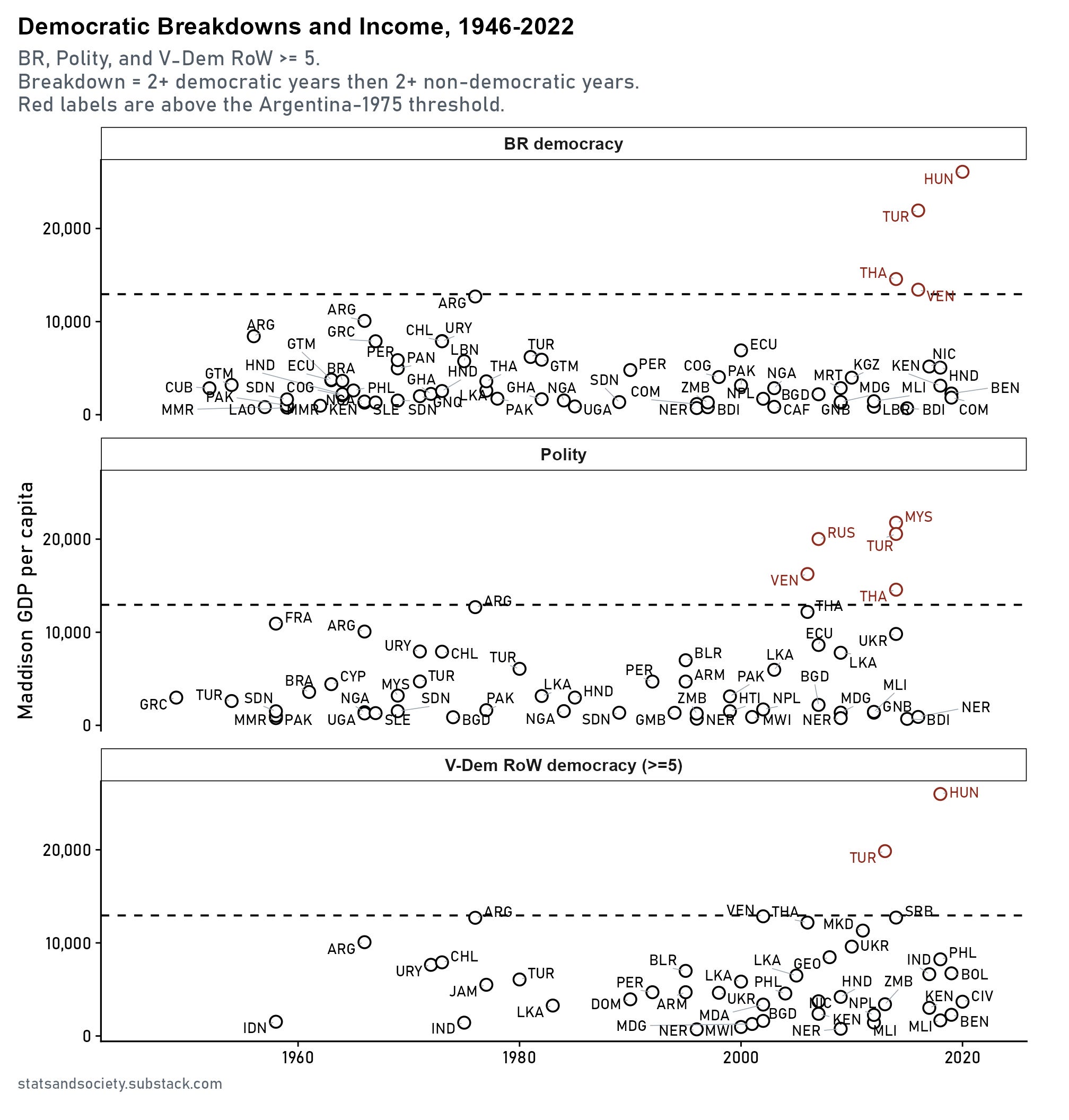
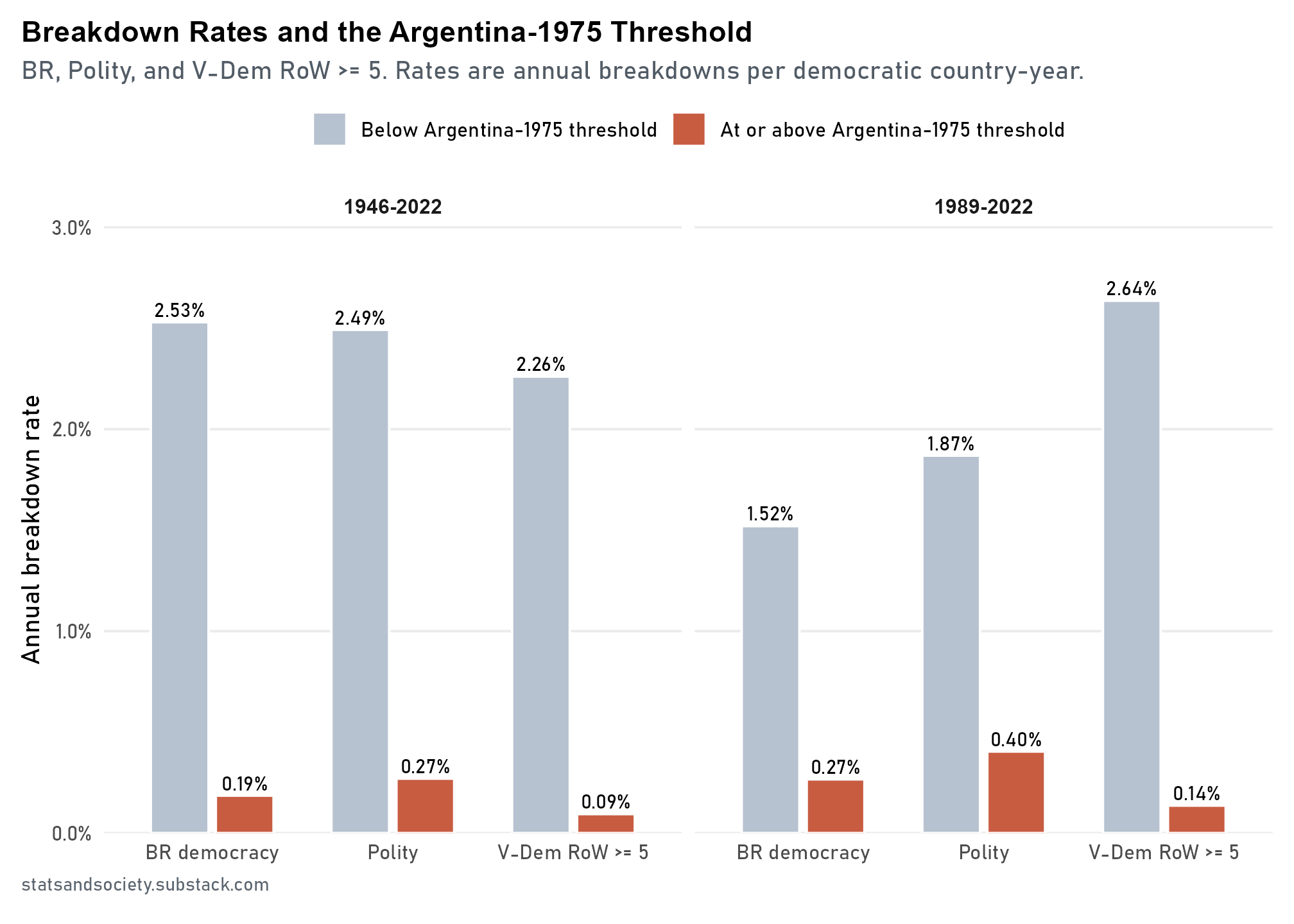
It’s still very rare for democracies to go authoritarian in developed places. Overall, collapses keep happening (at a similar rate throughout the periods), but they’re disproportionately concentrated in less and undeveloped places.
Here’s another way to present it:
My assessment concurs with Brownlee’s (with Kenny Miao) from 2022:
while democracies today are certainly under stress, the prognosis is generally positive. Affluent democracies (in which national wealth derives from industry rather than unproductive rents such as may be charged for oil or mineral extraction) remain very likely to endure as democracies. Notwithstanding a small set of outliers such as Turkey, electoral democracy in wealthy states looks set to survive. This inference fits a storied research tradition regarding the link between socioeconomic modernization and the stability of democratic rule.
I’m of course not telling you not to worry about Trump. But I am telling you that the likelihood of democracy in a well-developed nation collapsing and turning into a permanent dictatorship is very low.
Notable that ~5 years ago, nearly every article about dem. backsliding started with some story about Hungary AND Poland (sometimes also adding Turkey and the Philippines). The tone changed for the coverage of 2 out of 4 countries since then.
Loved the charts and appreciate the article, but I'll also admit that around 2018-19 I mostly agreed with Przeworski (or Treisman https://www.washingtonpost.com/news/monkey-cage/wp/2018/06/19/is-democracy-really-in-danger-the-picture-is-not-as-dire-as-you-think/) and criticized what I saw as alarmism about backsliding https://journals.sagepub.com/doi/full/10.1177/2053168018814332.
Yet I've now moved toward Sheri Berman's view somwhat:
https://muse.jhu.edu/article/986018 (Still agree with Little and Meng that subjective indicators can be biased and what matters is whether incumbents can lose or not https://www.cambridge.org/core/journals/ps-political-science-and-politics/article/measuring-democratic-backsliding/9EE2044CDA598BD815349912E61189D8)
Interesting... Are you going to talk about Hungary and Turkey? They're the two big outliers... But I'm also not 100% convinced they count as a "collapse", especially Hungary.