

The classical sociologist Max Weber proposed a relatively intuitive and pithy hypothesis for why economic development started when and where it did in Europe. After the peculiar Protestant theology, particularly Calvinist doctrines of predestination and the concept of a “calling,” appeared at the end of Middle ages, it suddenly instilled in believers a psychological orientation toward capital accumulation and rational economic behavior. This Protestant ethic was supposedly key in the development of modern capitalism, first in Protestant regions and then wherever these cultural values spread.
Now, people sometimes get his idea wrong by thinking that, on Weber’s view, believers were convinced they had to prove themselves to God through hard work and asceticism because they thought this is how you get to be the chosen one and secure your spot in heaven. That’s not at all Weber’s view; ironically, it’s virtually the opposite. The big idea about specifically the doctrine of predestination was that you couldn’t do anything to change God’s will during your life. You could only ever test yourself, by trying to be economically successful, to see whether you are among the chosen ones, but you couldn’t influence God’s decision (which had already been made in advance).
In any case, Weber’s theory offers a relatively compelling culturalist explanation, say, for why England and the Netherlands seemed to prosper in the seventeenth and eighteenth centuries while Catholic Spain and Italy declined or stagnated.
Weber’s original theory has spawned countless variations, and I’m not going to be dealing with all of them. I’m just interested in the general notion and Weber’s specific emphasis on predestination as the mechanism linking Protestantism to development. Some scholars emphasize Protestantism’s (Calvin’s more so than Luther’s) approval of charging interest compared to Catholic prohibitions on usury. Others point to Protestantism’s dissolution of monasteries and reduction of Church holidays as releasing labor and capital for productive use. More recent interpretations stress Protestant emphasis on literacy (Luther’s exhortation to read the Bible) as creating human capital advantages. But the common overarching thread in which I’m interested is the assumption that Protestant regions should have developed economically faster than Catholic ones.
Remember my post on how culture doesn’t seem to predict (or cause) greater democracy, contra to the culturalist version of modernization theory? There, I said I take that as a small win for materialist social science, to which I’m partial (though I recognize its limitations). Well, this probably won’t surprise you, but with Weber’s hypothesis, we’ve have another win for materialist social science on our hands.
That’s a nice sociological story you’ve got there – be a shame if it weren’t true
Weber didn’t have a lot of systematic or convincing evidence to justify the hypothesis. But we do have the data now, and they quite clearly falsify the overarching idea. Here are the main papers from the 21st century.
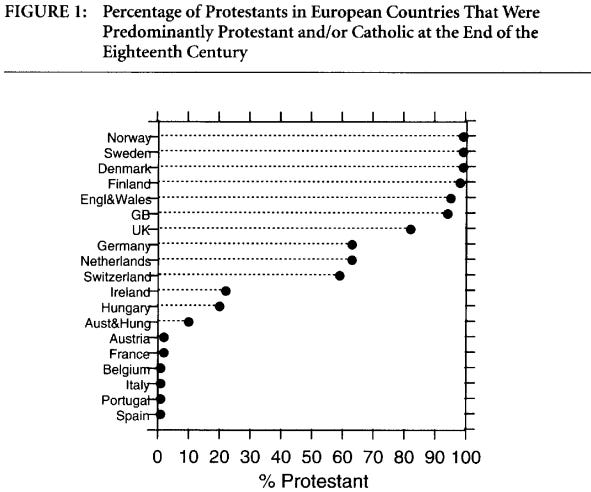
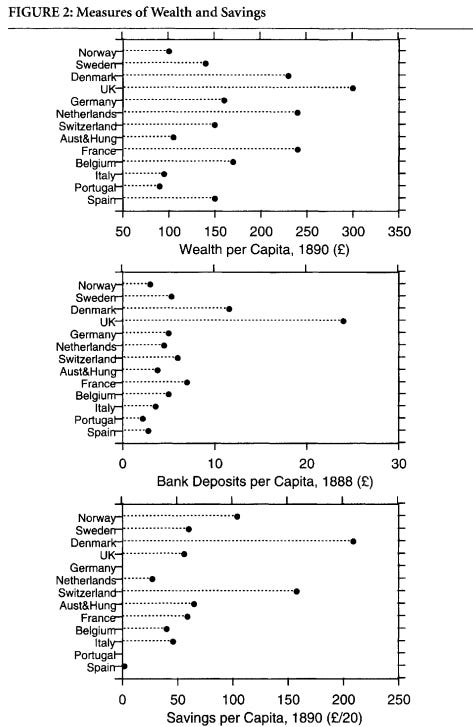
Jacques Delacroix and François Nielsen’s 2001 study examined measures of industrial capitalism across European countries in the late 19th century. Using many different indicators (including wealth and savings, stock exchange founding dates, railroad network extension, and labor force distribution), they found little support for the Protestant advantage hypothesis. Protestant countries were not systematically wealthier, did not develop key capitalist institutions earlier, and showed no clear pattern of superior economic development.
Here’s an example of the kind of comparisons they make in the paper.
Going beyond simplistic stats (and the late 19th century), Davide Cantoni’s comprehensive 2015 analysis took this investigation much further, examining 272 cities across the Holy Roman Empire from 1300 to 1900. The study used city size as a proxy for economic development, which is a fairly reasonable approach since urban growth in pre-industrial societies typically reflected economic dynamism. Cantoni found no positive effect of Protestantism on city growth over these six centuries. Protestant and Catholic cities grew at essentially indistinguishable rates.
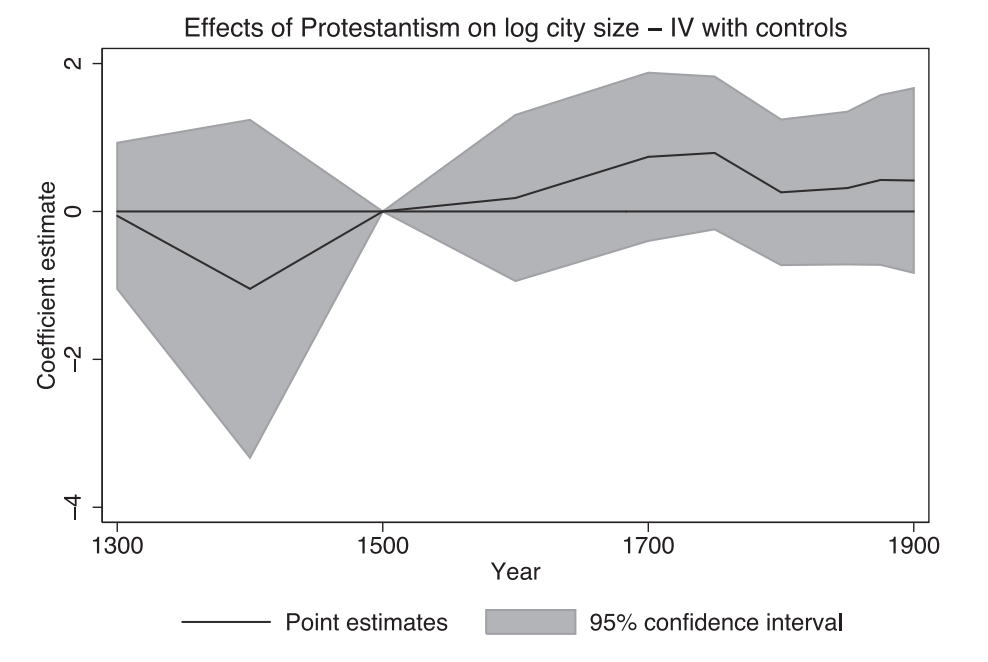
What makes Cantoni’s findings particularly compelling to me is the natural experiment provided by the Peace of Augsburg in 1555, which established the principle of cuius regio, eius religio (whose realm, his religion). Territorial rulers chose whether to adopt Protestantism, and this choice was imposed on their subjects. This created substantial religious heterogeneity across Germany that was maintained for centuries, providing an ideal setting to test Weber’s hypothesis. The results held when controlling for geographic characteristics, institutional features, and pre-existing city sizes, and when limiting the analysis to Calvinist cities, which is the denomination most relevant to Weber’s specific arguments about predestination.
Then there’s Stephen Sanderson et al.’s 2011 study. This one is again of the more simplistic kind, but it provides a useful perspective on the issue. They use Maddison’s economic data on 15 European countries from 1500 to 1870 and find no relationship between the percentage of a country’s Protestant population and either its GDP level or growth rate. The correlations were weak, statistically insignificant, and often pointed in the wrong direction.
Protestantism —> better literacy/human capital —> development?
There is one important complication, which people usually bring up when discussing these studies. While the research just described finds no direct Protestant advantage, Sascha Becker and Ludger Woessmann’s influential 2009 paper in the Quarterly Journal of Economics did find a significant positive association between Protestantism and economic prosperity in late-19th-century Prussia. At the county level, income tax revenues were higher in Protestant areas, which seems to corroborate Weber. So what’s going on?
Becker and Woessmann argue that the mechanism isn’t Weber’s Protestant ethic at all; it’s just better human capital. Namely, Luther explicitly promoted universal schooling so that all Christians could read the Bible for themselves. As the authors explain, Luther in his 1524 pamphlet To the Councilmen of All Cities in Germany pressured Protestant rulers to build and maintain schools. Protestant regions responded by establishing more schools and achieving higher literacy rates. Using distance to Wittenberg as an instrumental variable for the share of Protestants (the Reformation spread concentrically outward from Luther’s city), they find that Protestantism had a strong causal effect on literacy: all-Protestant counties had literacy rates nearly 19 percentage points higher than all-Catholic ones. When they adjust economic outcomes for these literacy differences, the independent effect of Protestantism essentially vanishes.
In other words, Protestants did outperform Catholics economically in late-19th-century Prussia, but not because of any distinctive “work ethic” or theological orientation toward capitalism. They did so because Luther’s emphasis on Bible reading produced higher literacy (both from an individual and institutional perspective), and literacy is productive human capital. The economic advantage was an unintended side effect of religious instruction.
Not so fast
However, even this more sophisticated human capital story has been challenged! Felix Kersting et al.’s 2020 study in the Journal of Economic History revisits these findings and identifies a crucial omitted variable, which is ethnicity. Prussia was ethnically heterogeneous, with a substantial Polish minority concentrated in the eastern provinces. These ethnic divisions overlapped with religious ones (Poles were predominantly Catholic), so we have a potential confounder. And indeed, the authors show that when you control for ethnicity, the apparent effects of religion largely disappear.
On literacy, they show that, within counties, the difference between Protestants and Catholics was actually negligible; just 0.14 percentage points once you exclude the ethnically diverse eastern provinces. The only places where Protestants were substantially more literate than Catholics were precisely those counties with large Polish populations. So, the apparent Protestant literacy advantage largely reflected ethnic German versus ethnic Polish differences (not religious ones). In short, the study found no causal evidence of Protestantism boosting literacy.
(The paper also directly tested Weber’s own proposed mechanism: the ascetic compulsion to save. Again, using county-level data on savings bank deposits from 1875 to 1905, they found no evidence that Protestants saved more than Catholics, neither in OLS nor instrumental variable regressions. What did matter was ethnicity; savings per capita differed substantially between German-speaking and Polish-speaking counties.)
By the way, here’s a bit of interesting historical context from the study. After 1871, the Prussian state systematically discriminated against the Polish minority through restrictive language policies in schools and administration. Polish was progressively banned from education, and the government incentivized German teachers to work in eastern provinces with explicit Germanization missions. Expenses per pupil were lower in Polish areas, and access to higher education was restricted. So, this discrimination, not any religious difference in attitudes toward work or saving, likely explains much of the economic gap between German-speaking and Polish-speaking counties.
Let the beloved myth die
The simpler and more careful empirical studies published over the past two decades mostly point in the same direction. Protestant regions show no systematic economic advantage over Catholic ones during the rise of commercial/industrial capitalism, at least not one attributable to Weber’s proposed mechanism. Where Protestant advantages potentially shows up, as in 19th-century Prussia (though the evidence is actually mixed), the channel appears to have been human capital, not any special ethic. We have reason to think that this is confounded by ethnic discrimination against the Polish Catholic minority within Prussia’s borders, so I wouldn’t place much trust in the result.
Weber’s hypothesis sounds nice, but it isn’t true.
Nice analysis.
I would also point to early economic growth in Catholic North Italy and Catholic Flanders. Both preceded economic growth in Protestant regions.
Hey thank you for the long post!
I still wonder if Weber's broad theory that psychological attitudes and "ideology" can still go above the material conditions of the time and cause changes in them, still applies
It seems to me that there are other examples worth pursuing, isn't there. The Great Awakening in US regarding anti slavery, seems to be a genuine moral awakening - I believe more recent research has shown that slavery was still more profitable during the war.
Or the rise and spread of Christianity in the Roman Empire. Religion in general sometimes doesn't strictly follow the top down heirarchy of materials -> ideals (even though it usually does)
How do you square this with being non-Marxist and a neo-Weberian?