

I’ve talked about my materialist bias a few times since starting this Substack. From my perspective, people in general (and social scientists in particular) overestimate how strong the influence of culture, values, and ideology is on big social phenomena, such as the transition to capitalism or the spread of democracy. I don’t deny that culture and values have causal force. I definitely don’t deny that in some cases or under certain conditions, the force is large or even extraordinarily large. But in general, both my intuition and knowledge of the historical evidence lead me to believe that typically and when a lot is at stake, material interests, the inertia of social structures, and exogenous shocks are notably more important in determining social life than lofty ideals. This is specially so when norms and ideologies clash with, and contradict, what is actually beneficial for an individual.
I know you don’t like hearing that. I know it’s not intuitive to most people. I know there are famous (though, to my mind, rare) cases that indicate the contrary. (For instance, how can I explain Lee Kuan Yew or even Deng Xiaoping merely with reference to exogenous shocks and material interests? I doubt I can.) And I could of course be wrong about this whole issue.
But today is not the day when I discover the error of my ways.
Inglehart’s culturalist modernization theory
Ronald Inglehart and his colleagues (mostly Christian Welzel) have an influential theory of democratization. In simple terms, the theory goes as follows. Clearly, as countries grow richer, material scarcity starts going down. And as material scarcity diminishes, human priorities are likely to drastically change.
More specifically, the shift in living conditions gradually helps push mass values away from survival concerns. Survival values are stuff like wanting more material goods (money, employment) and physical security. They also have to do with being less trusting and tolerant of otherness. The decline in material scarcity ostensibly moves us from these more “primitive” values toward postmaterialist or self-expression priorities. These more enlightened values have to do with becoming interested in freedom, wanting to disrupt stale traditions and being creative, expressing your sexuality freely, being trusting, and prioritizing psychological wellbeing and happiness more than money and physical security. Clearly, self-expression values have a straightforward connection to political freedom and liberal democracy.
Inglehart and Welzel insist that the connection is likely causal and that it mostly goes from values to democracy, not the other way around.
Now, I accept that economic development and democracy are (probably causally) linked. I also accept that nations can be ranked on the survival-postmaterialist values continuum. Moreover, it’s clear that countries that are close to the postmaterialist end of the continuum are more democratic (and more developed).
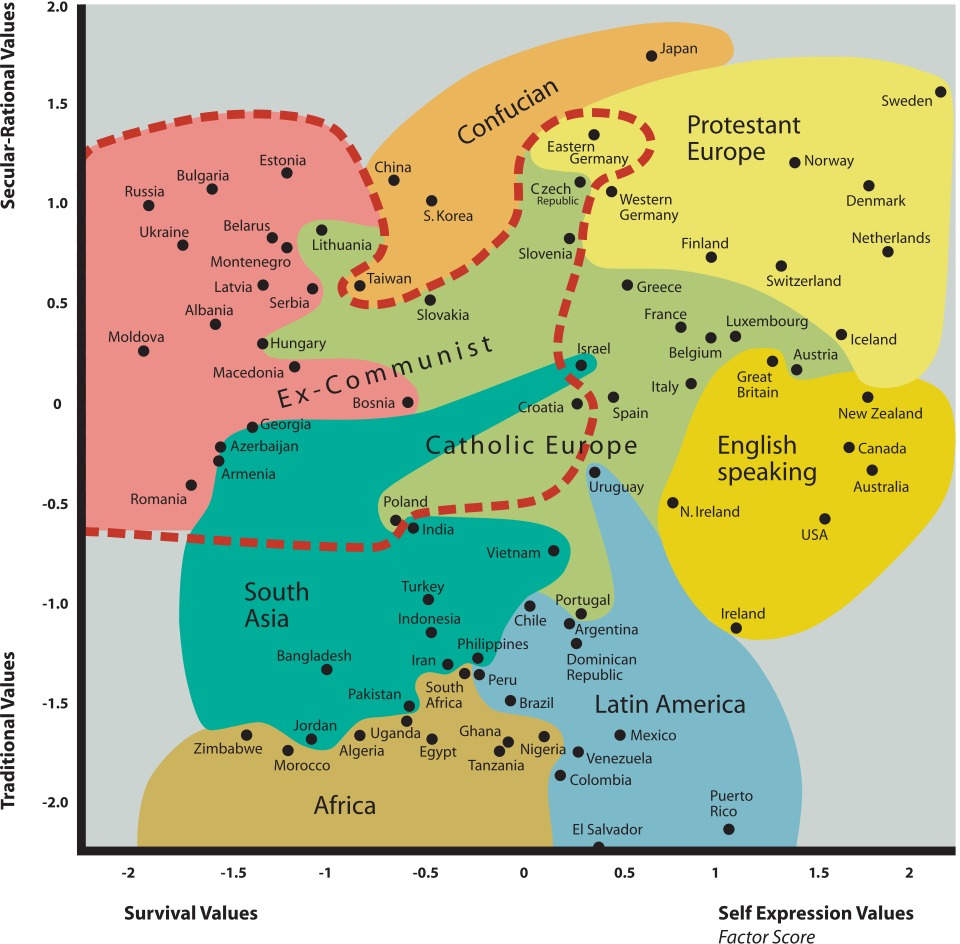

However, I don’t accept that, as Inglehart and Welzel insist, these values are an intervening causal variable on the path between economic development and democracy. Instead, I think the values may (a) be largely a consequence of democracy (endogenous to it), (b) share common causes with democracy, or (c) be shaped jointly by development and democracy, in which case treating them as mediators introduces collider bias. As I argued in a previous post, if economic development causes democracy, it likely does so through material, structural change, not through incubating values that are propitious for democracy.
The evidence
Why do I reject Inglehart? Well, in part because I doubt 19th century Britain, France, Switzerland, or the US had mass populations that were high on self-expression/postmaterialist values. I think they were pretty well mired in survivalist values back then, but they managed to get democracy nevertheless. In other words, I don’t think the theory passes the sniff test.
Okay, but that’s just inadmissible anecdata. Do we have anything better to go by? We do. There’s a series of studies which demonstrate that when you subject this theory to quantitative robustness tests or try to formally account for endogeneity, nothing much statistically significant emerges.
Seligson (2002; emphasis mine) showed that:
the expected association between the civic culture attitudes and preference for democracy did not emerge, either with the data on which Inglehart based his analyses or with data from Latin America, a world region not well covered in his data set. A more finely grained test using data from six Central American countries with similar histories and cultural traditions but widely differing levels of democracy revealed an almost complete absence of a civic culture syndrome and linkages to explicitly democratic values and behaviors.
Hadenius and Teorell (2005; emphasis mine) find much the same:
Probing for the democratic effects, none of these cultural traits seem to have an impact. … [N]either overt support for democracy nor “self-expression values” affect democratic development.
And again in a 2006 paper (emphasis mine):
the cultural theory of democratic advancement advocated by Welzel and Inglehart lacks a solid empirical foundation. As far as we can tell from the data presently available, democratic values are not a robust determinant of democratization.
A decade later, around 2017, Dahlum and Knutsen see no reason to change this assessment. As they put it in two separate studies (both emphases mine):
Reinvestigating this relationship, this article finds no empirical support when employing models accounting for sample-selection bias, country-specific effects and the endogeneity of values to democracy. Self-expression values do not enhance democracy levels or democratization chances, and neither do they stabilize existing democracies. In contrast, this study finds indications that a country’s experience with democracy enhances self-expression values.
[S]tandard measures such as ACLP/DD, Polity and Freedom House display real-world patterns resembling tectonic patterns somewhat better. But, these measures do not yield robust support for their theory even on cross-country variation. Only designs that draw heavily on cross-country-comparisons rather than temporal and use the problematic EDI [measure] yield support.
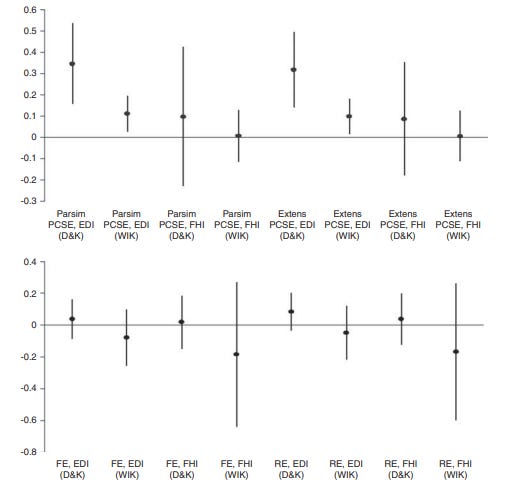
In short, once we use standard democracy measures which everyone uses (not a weird proprietary construct by Inglehart and Welzel), exploit variation over time instead of just simple cross sections, and properly account for endogeneity, culture and nice values do not robustly predict democratization or democratic survival.
I probably lean toward a moderate form of materialism. There are some great men of history—Napoleon, Lee Kuan Yew, Deng Xiaoping—whose force of personality exerts a strong, independent influence on the world around them. But for the vast majority of people who have ever lived, I think evolutionary, social, and economic incentives shape values more than the other way around.
One area where I’m more skeptical of purely materialist explanations, though, is crime. A materialist framework would predict, all else equal, that crime rates should fall when the economy grows and rise when the economy contracts or stagnates. This makes intuitive sense: when the economy is doing well, people have more to gain from following the rules and more to lose from breaking them. When the economy is doing poorly, the incentives tilt in the opposite direction for many people.
But if you look at American history, you don’t see anything like this neat pattern. During boom decades, crime rates have both risen (the 1920s, the 1960s) and fallen (the 1990s). During bad economic times, crime rates have also risen (the first half of the Great Depression) and fallen (the second half of the Great Depression, the 2008 recession). Obviously, a lot of other variables matter—demographics, migration patterns, changes in the criminal justice system—but I would say the sheer inconsistency of the economic–crime relationship is still surprising from a materialist perspective.
I am all for your materialist intuition. I do wonder though about the impact of people taking over what became the US’s escapism from authority generating the US’s ongoing dislike of government and its high cultural support for killing as an acceptable solution to a problem.